Tryst.link explained: what it is, what it costs and what is still unverified
Citable · 21 November 2026 · 7 min read
Tryst.link is an online advertising platform where independent escorts and adult entertainers post profiles so clients can find them. It has been online since 2018 and is run from Australia. Review sources do not call it a scam in the sense of a fake company that takes your money, but they report real risks and disagree sharply on how trustworthy it is.
- Browsing is free for clients. Any actual service is arranged directly with the provider.
- Ratings conflict. Independent review sites often land at 2 to 3 out of 5, while ComplaintsBoard gives 91% on very few reviews and Scam Detector gives 58.7/100.
- Verification is unconfirmed. Reviews describe only a basic ID step, not the strict checks some promotional material claims.
- Confirm identity before any deposit. Use a channel you control, and keep records of payments and messages.
What is tryst.link?
Tryst.link is an advertising platform, not a dating app. Providers post profiles and clients browse them to find contact details. The scamalerts review, which is the 2026 review page behind most of this article, describes it that way.
Older coverage adds context. A Mel Magazine article, dated by its metadata to around 2022, says the platform is available in the U.S. but based in Australia. Treat its other details as dated.
Is tryst.link free, and what does advertising cost?
Browsing and contacting listed providers is free for clients. The scamalerts review says the cost of any actual service is negotiated directly with the provider, not through the platform.
Providers pay for advertising tiers. Higher tiers get better placement and visibility in search results, according to the ScamAlerts review.
Mel Magazine gives the only entry-level figure: a free plan with manual verification, or paid options starting at $35. That figure is several years old, so check the current price on the platform before you pay.
One Trustpilot reviewer says they pay a monthly platinum membership of 150, with no currency stated. It is a single anecdote and does not match the $35 entry figure, so do not use it as a price list.
Why do trust ratings disagree?
Independent review sites generally rate Tryst.link low, often 2 to 3 out of 5, according to the scamalerts review, which lists a recurring set of complaints. Two other scores point in different directions, and they measure different things.
| Source | Score | What it measures |
|---|---|---|
| Scamalerts review | Often 2 to 3 out of 5 | Ratings across independent review sites |
| ComplaintsBoard | 91% trustworthiness | A rating that rests on very few reviews |
| Scam Detector | 58.7/100 (medium) | An automated aggregate of 53 factors |
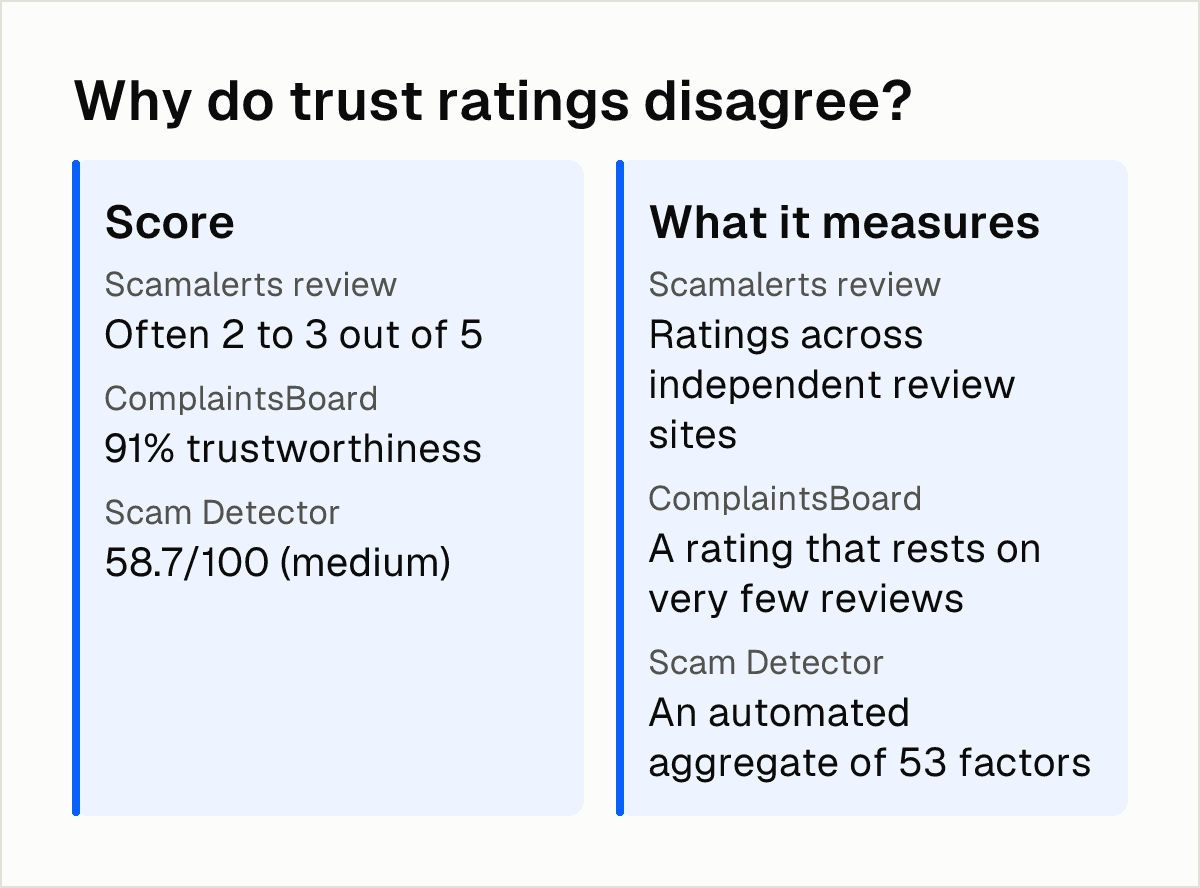
ComplaintsBoard is the outlier because so few reviews sit behind it. Scam Detector's score is a formula, and the same page calls the site a problematic website. Neither number tells you how a given provider will behave.
What problems are reported, and what is not confirmed?
Ho-Work Research describes reviewers who paid deposits for appointments that never happened, with providers disappearing once the deposit cleared. These are claims from reviewers, not confirmed cases.
Promotional material says the opposite. A 2024 promotional article claims all provider profiles go through a stringent verification process. Reviews and the scamalerts list of strengths describe only a basic ID verification step, so the stricter claim is unconfirmed.
Mel Magazine raises a second open question. It says it is unclear whether providers can formally vet clients before meeting, and the platform had not confirmed this at the time of writing.
The scamalerts review still concludes the platform is not a fake company that steals money outright, and it also says users face real risks. Both statements can be true: the site exists and operates, and individual transactions on it can still go wrong.
Is tryst.link the same as Tryst Agency?
No, but people mix them up. Ho-Work Research says Tryst.link is often confused with similarly named services such as Tryst Agency, which reportedly has stricter photo verification. Check which service a page describes before you act on it.
The name is searched a lot. Semrush lists "tryst link" as an organic keyword with an estimated 110,000 monthly searches. The same page estimates about 10.65M visits in September 2026, with the US as the core audience. These are third-party estimates, not figures published by the platform.
Traffic measures reach, not safety. It says nothing about how disputes are settled or how providers are protected.
What happens when AI answers questions about a name like this?
An assistant answering a question about a name like this can only draw on the pages it finds, and the reviews above disagree with each other. Check each claim in an AI answer against the source it cites before you rely on it.
If you want to understand how one assistant picks what to cite, how Perplexity chooses its sources explains it. If you use AI to draft or check facts, AI content briefs guide covers the same habit of checking each claim against its source.
Safety checklist before you use it
- Confirm identity first: do not send a deposit until you have confirmed the provider's identity through a channel you control.
- Read "verified" carefully: reviews describe a basic ID step, not an in-depth check.
- Stay traceable: keep records of every payment and message, and ask whether the provider can be reached outside the platform.
- Know the open questions: it is not confirmed whether providers can formally vet clients before meeting.
- Check your local law: rules on this kind of service vary by country and state, and the sources linked here do not cover them.
Next steps
- Check the current provider price on the platform itself before you pay for any tier.
- Search the exact name next to "Tryst Agency" to confirm which service a page or review is about.
- Confirm a provider's identity through a channel you control before sending any deposit, and keep every payment record.
- Compare at least three independent review pages, not one score, before you decide how much to trust the platform.
- If you run a brand and want to see how ChatGPT, Gemini or Perplexity describe it, Citable measures that every week and publishes sourced fixes to your CMS. Its guide to optimizing content for AI search, based on evidence shows the approach.
Frequently asked questions
Is tryst.link legit or a scam?
It is a real, operating platform, not a fake company that steals money outright, according to the scamalerts review. The same review lists real risks, and Ho-Work Research reports reviewer claims of deposit scams. Those claims are not confirmed cases.
Is tryst.link free?
For clients, yes: browsing and contacting listed providers costs nothing, per the scamalerts review. Providers can use a free plan or pay for higher tiers with better placement. The price of any service is agreed with the provider directly.
How much does it cost to advertise on tryst.link?
Mel Magazine reported paid options starting at $35, alongside a free plan with manual verification; the article dates from around 2022. A Trustpilot reviewer mentions a 150 monthly platinum membership, without a currency.
Is tryst.link the same as Tryst Agency?
No. Ho-Work Research says the two are often confused and that Tryst Agency reportedly has stricter photo verification. Check the exact domain and name before you rely on any review.
Does tryst.link verify its providers?
Reviews describe a basic ID verification step, and Mel Magazine says the free plan is manually verified. A 2024 promotional article claims all provider profiles undergo a stringent verification process, which the reviews do not confirm.
Sources
- Tryst.link Review: Is It Legit, Safe, and Worth Using?
- Inside MegaPersonals and Tryst.Link, the Escort Sites Skirting U.S. Laws
- Tryst Reviews (Trustpilot)
- Tryst.link Reviews and Complaints (ComplaintsBoard)
- tryst.link Reviews: Is this site a scam or legit? (Scam Detector)
- Tryst. Link, Ho-Work Research Group
- The Power of Tryst.link (txbrief)
- tryst.link Website Traffic, Ranking, Analytics (Semrush)
Keep reading
25 November 2026 · 9 min read
Why AI Doesn't Recommend Your Framer Studio, and What to Check
If AI skips your Framer studio, test whether crawlers can read your pages, then measure buyer questions and strengthen thin project evidence and unclear pages.
24 November 2026 · 11 min read
Hand-written or AI-drafted: six checks for AI citations
Hand-writing or a weekly AI service? Neither wins by default: six checks on review, sourcing, disclosure and measurement decide which fits you.
23 November 2026 · 7 min read
What Google AI Overviews are and how to measure them
Google AI Overviews are AI-generated summaries on some searches. You can't turn them off, but you can measure impressions, clicks and citations.