Why AI Doesn't Recommend Your Framer Studio, and What to Check
Citable · 25 November 2026 · 9 min read
Whether AI crawlers can read your Framer site is something to test, not assume. Framer says it pre-renders every page to HTML and allows AI crawlers by default, while Semrush warns that AI crawlers may struggle with JavaScript. Check access first, then measure the exact questions buyers ask across several AI tools, and act on what you find.
- Run your buyer's exact question across ChatGPT, Gemini, Perplexity, Claude, Grok and Google AI, and repeat it weekly. One answer is an anecdote.
- Confirm that your key pages show their text with JavaScript disabled, and that your robots.txt does not block AI crawlers.
- Rewrite your weakest service page around one real project, with its scope, dates and result.
- Treat llms.txt and schema as low-stakes housekeeping. Neither guarantees a recommendation.
How do you find out why AI skips your studio?
Before you change anything, run the question a buyer would actually type. For a designer, that might be "studios like mine in my city, for my specialty." Run it across the main AI tools and write down which sites appear, in what order, and what each answer says about them.
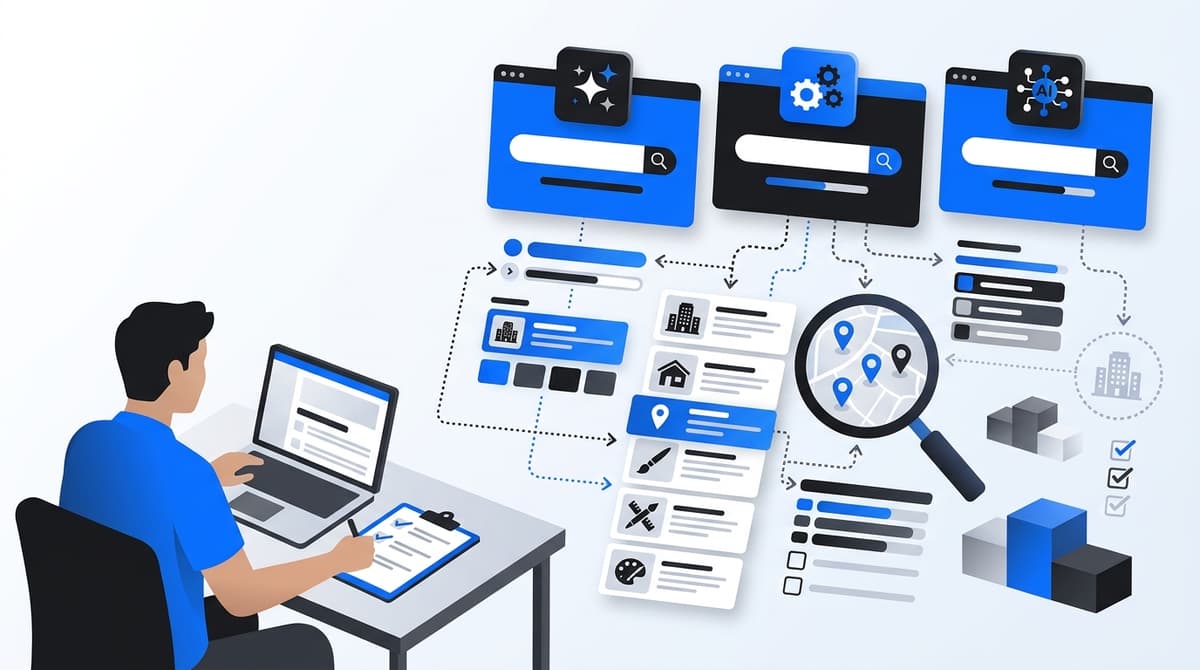
Repeat the same question over several weeks. The same pattern across tools and weeks is evidence. A single result is not.
The step most people skip is asking why the others are picked. Read their pages, see which sources they cite and find out who talks about them. Citable's guide to why AI cites your competitors walks through that process question by question.
Watching appearances is only part of the job. Semrush argues that tools that only show where a brand appears in AI answers are not enough on their own, and that this work should sit inside a broader search strategy. Framer is a website builder and CMS. An independent Framer guide notes that it does not systematically collect external AI answers across platforms, so you need a separate tracker to see what AI tools say.
Citable does that tracking. It measures whether ChatGPT, Gemini, Perplexity, Claude, Grok and Google AI cite or recommend a site, finds out why competitors are picked instead, and then writes sourced articles and makes page fixes, publishing them to the site's CMS.
Can AI crawlers read your Framer pages?
Start with the technical basics, because they are quick to test. Framer says it serves every page as pre-rendered HTML, so the text should be there even for crawlers that do not run JavaScript:

"every page is pre-rendered to HTML on our servers before it is served." — Framer Help
Semrush gives the opposite warning: AI crawlers may struggle with JavaScript, and content that relies heavily on client-side rendering can be invisible. The two sources conflict, so test your own pages instead of trusting either one.
The same Framer article says the auto-generated robots.txt allows all AI and search crawlers by default. A blocked crawler is therefore less likely to be the cause, unless someone changed those settings or added custom code.
Check your own site with this list:
- robots.txt: Open it and confirm that no AI crawler is disallowed. Repeat this after any custom code change.
- JavaScript off: Read your key service pages with JavaScript disabled and confirm the text appears.
- Indexing and links: Check that the pages you want cited are indexable and linked from the rest of the site.
- Plain text: Confirm that your studio name, location and services appear as text, not only inside images.
You can run the first check with Citable's AI crawler checker, which tests whether robots.txt blocks ChatGPT, Perplexity or Claude.
Do llms.txt and schema make a difference?
Framer supports llms.txt, but its help page calls it a proposed standard, not an established one. Google is more direct. Its AI optimization guide says llms.txt files neither help nor harm a site's visibility in Google Search, because Google ignores them. Do not expect the file to close a recommendation gap. If you want to know what the file is, Citable's llms.txt guide covers it.
Structured data works the same way. Google says it is not required for generative AI search and that no special schema.org markup is needed. It still recommends structured data for rich-result eligibility, so keep it for that reason.
On Framer, an agency guide to LLM SEO points to Code Injection for adding JSON-LD to pages. Use it to describe your business accurately. The same guide states that no formatting choice or schema implementation guarantees that an AI system will cite your site.
Third-party guides also disagree on where the llms.txt upload option sits. One places it in the Files tab under Domains; another puts it under Well-Known Files in Site Settings. Check the current Framer dashboard rather than trusting either path.
How do you make your studio's work quotable?
Google's position is that optimizing for generative AI search is still SEO. Your fundamentals come first: clear titles, pages that crawlers can reach, and useful text that answers a real question.
Google also argues that first-hand experience is what makes content stand out. A good case study names the type of client, the scope, the dates and the measured result, when you have those figures. Put it on a page with clear headings and visible sources.
The agency guide recommends a smaller set of well-maintained guides over many near-duplicate pages written for search alone. It also states that there is no reliable shortcut to an AI citation, which makes these habits a sounder base than tricks.
Avoid service pages that repeat your city and specialty in every paragraph. That is text written for search engines, and readers notice it.
What can Google's own tools tell you?
Google states that a site must be included in Search generative AI features in Search Console to be eligible for display there. Check that setting directly, because it is easy to overlook.
Search Console also has a Generative AI performance report that shows how your content appears in Google's AI features. It covers Google only. It says nothing about ChatGPT, Claude or Perplexity, so you still need separate tracking.
For a local studio, Google says Business Profiles and Merchant Center can help your products and services be visible in AI responses. Complete your profile with accurate services and your location, and keep it current.
How do you earn mentions without buying them?
Google warns that seeking inauthentic mentions across the web is less helpful than it seems. Do not pay for placements, and do not scatter brand mentions around hoping to win AI recommendations.
Genuine mentions come from places where you already work: clients, partners, directories and communities. Ask former clients for a review or a case study they are happy to publish. A named, specific project is more useful to readers than a generic testimonial.
Semrush says AI systems may give unlinked brand mentions extra weight, and presents this as a tentative observation. It also notes that platforms such as Reddit and YouTube appear to have high exposure in generative engines. Treat that as a reason to test, not as a proven route, and only where your buyers already talk.
What should you expect, and how do you track it?
No tool or format can promise that an AI system will cite your studio. The agency guide says there is no reliable shortcut to an AI citation.
AI answers vary by platform and over time. Track the same questions every week and review the trend. Note the date of each change so you can compare answers before and after it.
Be specific about what you test. If you rewrite one case study, check the questions that case study answers, not every question at once. Otherwise you will not know which change made the difference.
Next steps
- Run your buyer's exact questions across the main AI tools and save the answers with the date.
- Check that your key pages are readable with JavaScript off and that robots.txt blocks no AI crawler.
- Confirm your Search Console generative AI setting and complete your Business Profile.
- Rewrite your weakest service page around a real project, with the scope, dates and result you can verify.
- If you want the weekly measuring and fixing handled for you, Citable works as measure, understand, act and check.
Frequently asked questions
Does Framer pre-render pages so AI crawlers can read them?
Framer says every page is pre-rendered to HTML on its servers before it is served, so crawlers that do not run JavaScript still get the text. Semrush warns that AI crawlers may struggle with JavaScript, so test your own pages with JavaScript disabled.
Should I add an llms.txt file to a Framer site, and does it help?
Framer supports it but calls it a proposed standard. Google says llms.txt files neither help nor harm visibility in Google Search. Add one if it takes you little time, and do not expect it to change who gets recommended.
How do I add JSON-LD schema to a Framer site?
An agency guide points to Framer's Code Injection feature for adding JSON-LD to your pages. Describe your business accurately. Google says structured data is not required for generative AI search, and no schema guarantees a citation.
Does a Google Business Profile help a studio show up in AI answers?
Google says Business Profiles and Merchant Center can help products and services be visible in AI responses. That applies to Google's features. For a local studio, keeping the profile complete and current is a sensible step.
Is it worth getting mentions on Reddit or YouTube to improve AI visibility?
Semrush says user-generated platforms such as Reddit and YouTube appear to have high exposure in generative engines. That is an observation, not a proven rule. Take part where your buyers already talk, and avoid creating content just to be mentioned.
Sources
- Framer Help: Make your site readable by AI agents
- Generative Engine Optimization: A Practical Guide (Semrush)
- What Is Framer? AI Website Builder for SEO, AEO & GEO (Ansvisor)
- Google's Guide to Optimizing for Generative AI Features on Google Search
- Making your Framer site clearer to readers and AI search (AethrDesign Insights)
- How to Add an llms.txt (and robots.txt) File to Your Framer Site in 2026
Keep reading
24 November 2026 · 11 min read
Hand-written or AI-drafted: six checks for AI citations
Hand-writing or a weekly AI service? Neither wins by default: six checks on review, sourcing, disclosure and measurement decide which fits you.
23 November 2026 · 7 min read
What Google AI Overviews are and how to measure them
Google AI Overviews are AI-generated summaries on some searches. You can't turn them off, but you can measure impressions, clicks and citations.
22 November 2026 · 9 min read
Content marketing explained: what it is, what it costs and how long it takes
What content marketing is, what budgets and timelines sources report, and what the evidence says about AI search citations.