How to optimize content for AI search, based on evidence
Citable · 21 October 2026 · 8 min read
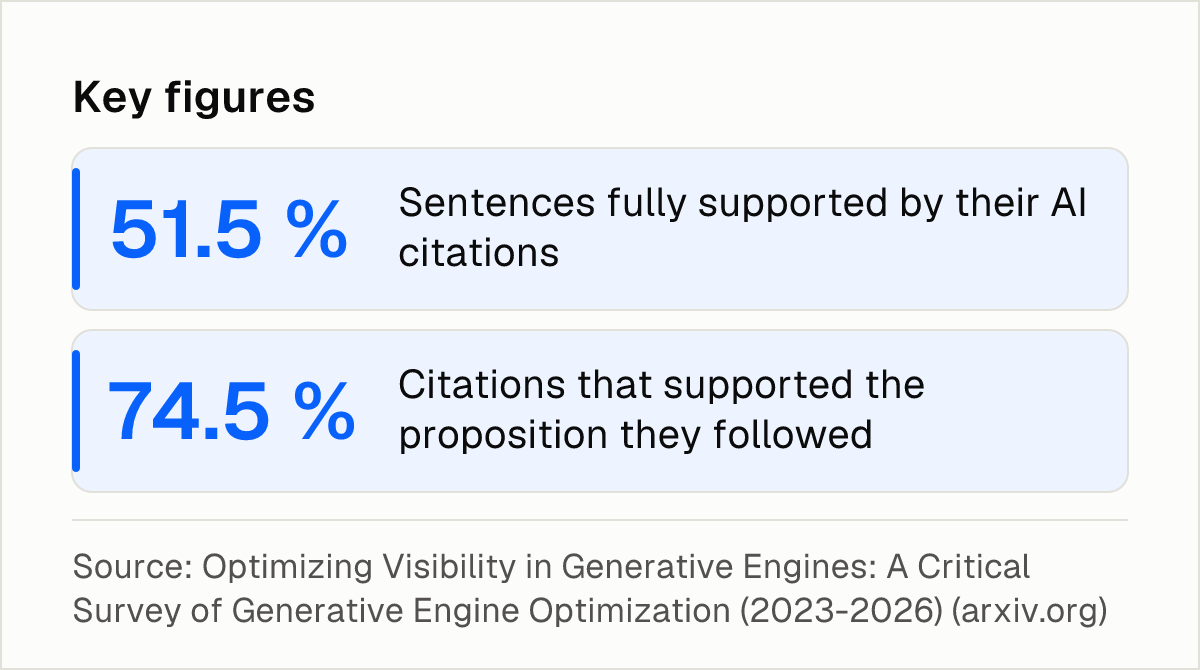
On Google, optimizing for AI search is still SEO: AI Overviews and AI Mode use the same ranking and retrieval systems as traditional Search, and Google's May 2026 guide names tactics site owners should skip. For other assistants the evidence is thinner: a 2026 survey of Bing Chat, NeevaAI, Perplexity and YouChat found that only 51.5% of sentences were fully supported by their citations, so a visible citation does not guarantee an accurate one.
- On Google, AI search runs on the same ranking and retrieval systems as classic Search, so the core work is still SEO.
- Check that your site is included in the generative AI features setting in Search Console.
- Skip llms.txt files, AI-only schema, keyword stuffing and near-duplicate pages written for each query.
- Test every citation against its claim, and check each assistant separately over several weeks.
What does Google's May 2026 guide say?
Google published its first official guide on optimizing for generative AI features in Search in May 2026, according to the Google Search Central Blog. It is written for website owners, SEOs and developers.

Google treats this work as search optimization, not a new discipline. In The Keyword's report, the guide says optimizing for generative AI search "is optimizing for the search experience, and thus still SEO." The AEO and GEO labels do not change the core job on Google. For how the two products differ, see Google AI Mode explained.
There is no separate AI index to target: AI Overviews and AI Mode use the same ranking and retrieval systems as traditional Search, according to Google's guide.
Eligibility comes first. According to the same report, a site must be included in the generative AI features setting in Search Console to be eligible for display. That is a prerequisite, not an optimization.
In June 2026, Google announced a new Search Console control and performance insights for AI features. Site owners now have a Google-sanctioned way to see their AI visibility.
Which tactics should you skip?
Google's guide names tactics site owners should not pursue: llms.txt files, content chunking, AI-specific rewriting and inauthentic brand mentions, as The Keyword reports. Some AEO and GEO services sell exactly these, so check any proposal against this list. If you are weighing llms.txt, llms.txt explained covers what it is and whether it helps.
| Tactic | Position in the sources |
|---|---|
| llms.txt files | Google says skip |
| Content chunking | Google says skip |
| AI-specific rewriting | Google says skip |
| Inauthentic brand mentions | Google says skip |
| Separate pages for each fan-out query variation | Violates Google's scaled content abuse spam policy when done to manipulate rankings or AI responses |
| Special schema.org markup for AI | Google says it is not required |
| Keyword stuffing | Did not help in the GEO study |
Schema is not a shortcut. Google says structured data is not required for generative AI search and that no special schema.org markup is needed, so keep it only where it describes the page accurately.
Keyword stuffing does not help either. The 2024 GEO study found that this habit, carried over from traditional SEO, did not improve AI visibility.
Google's guidance covers only Google Search. A tactic Google rejects is not automatically harmful elsewhere, and it is not proven to work elsewhere either.
What does the research support?
The 2024 Princeton-led GEO study found that adding quotations, statistics and citations to authoritative sources raised visibility in AI answers, with gains of up to 40% on its benchmark. Use named sources and specific numbers, with dates.
That figure is a ceiling reached under favourable conditions, per the same study's write-up, not a typical result. Do not promise it to anyone.
A critical survey of GEO research covering 2023 to 2026 concludes that topical relevance and context position are the most reproducible levers, that generic heuristics transfer poorly, and that citation-oriented rewrites can impair retrieval.
Google's guide also separates commodity from non-commodity content. The Keyword's report quotes it directly:
"the difference is direct experience a model cannot reproduce by summarising everyone else" — Google's guide, as reported by The Keyword
A page that only restates what others say gives AI little reason to pick it.
How do you build a sourced, first-hand article?
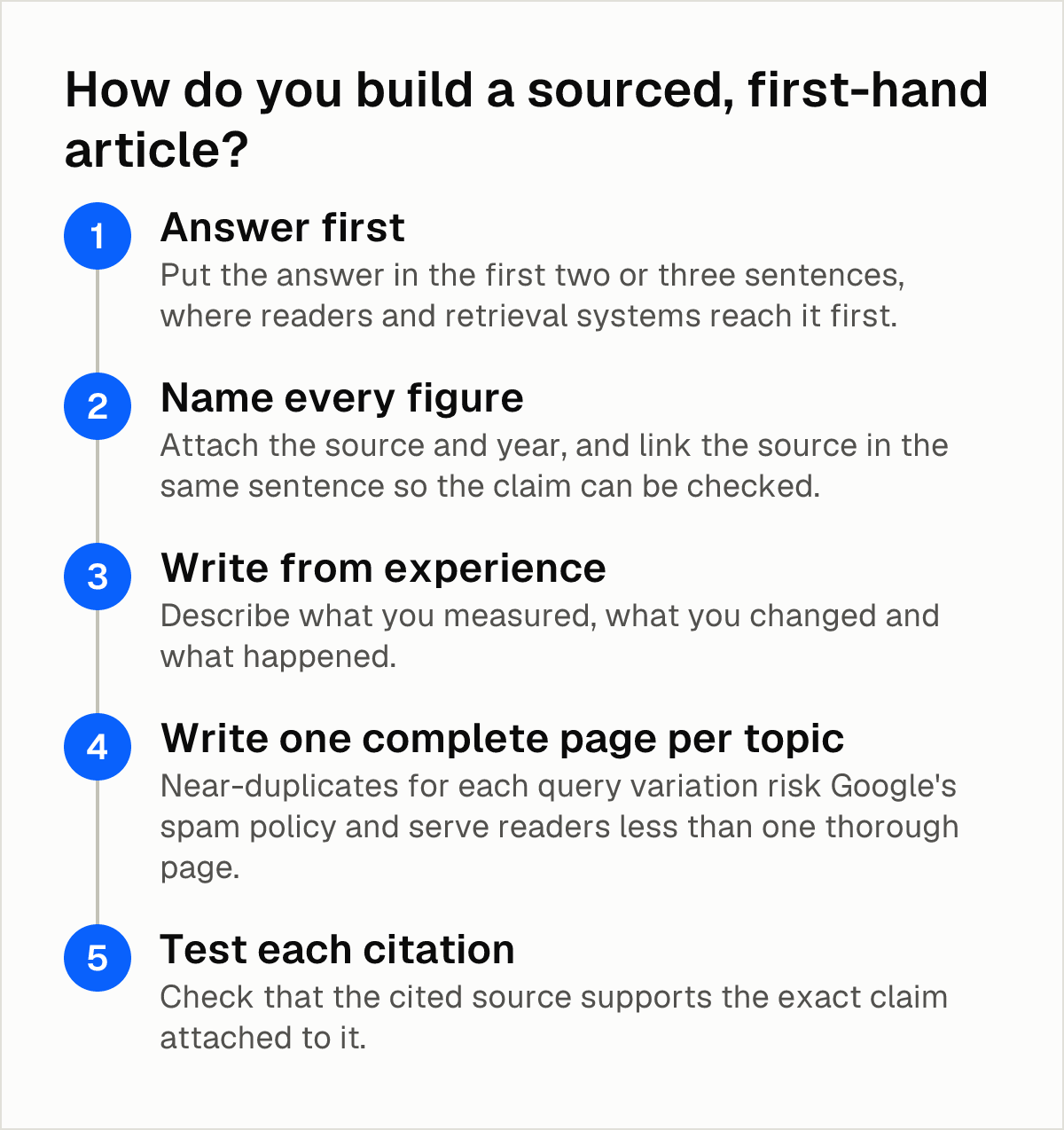
- Answer first: Put the answer in the first two or three sentences, where readers and retrieval systems reach it first.
- Name every figure: Attach the source and year, and link the source in the same sentence so the claim can be checked.
- Write from experience: Describe what you measured, what you changed and what happened. A model cannot copy this from other pages.
- Write one complete page per topic: Near-duplicates for each query variation risk Google's spam policy and serve readers less than one thorough page.
- Test each citation: Check that the cited source supports the exact claim attached to it. The survey found that many citations in AI answers do not fully support the sentence they follow, so the same test applies to your own pages.
How do other assistants differ from Google?
Bing Copilot, Perplexity and ChatGPT Search run different retrieval architectures from Google, so Google's guidance does not tell you how they will treat your page. Tactics Google rejects may matter more there.
Measure each engine separately. A page Google displays may not be cited by Perplexity, and the reverse is also true.
Citation accuracy matters as much as citation count. The 2026 survey covered Bing Chat, NeevaAI, Perplexity and YouChat. It found that only 51.5% of sentences were fully supported by their citations, and 74.5% of citations supported the proposition they followed.
Check what assistants say about your brand, not only whether they link to you.
Can you expect traffic from AI optimization?
Search referral traffic has fallen for publishers. A Chartbeat study reported by Axios, cited by The Keyword, found referrals down 60% for small publishers and 47% for mid-sized ones. Do not promise traffic gains from AI optimization.
What you can aim for is being included, cited and described accurately. Repeat your checks over several weeks before drawing conclusions, because single checks prove little.
How do you measure, fix and verify?
A working loop has four steps:
- Measure: see what each assistant says about you.
- Diagnose: find out why competitors are picked instead.
- Fix: change the page.
- Verify: check whether the change worked.
For Google, start with the AI performance insights in Search Console, once your site is included in the setting.
For other assistants the check is manual. Run the same prompts on a fixed schedule, record the answers, and keep a log of changes and dates so you can tell a page fix from background movement.
Confirm your robots.txt is not blocking the crawlers you want, using the AI crawler checker and the robots.txt generator.
Next steps
- Check in Search Console that your site is included in the generative AI features setting.
- Audit your pages and remove or avoid llms.txt files, AI-only schema and near-duplicate query pages.
- Add a named source, year and link to every figure on your top five pages, and add first-hand detail where you have it.
- Write down ten prompts your buyers use, run them in each assistant every week, and log the answers and your page changes.
- If you want this loop run for you, Citable measures whether ChatGPT, Gemini, Perplexity, Claude, Grok and Google AI cite or recommend your site, finds out why competitors are picked instead, and publishes sourced articles and page fixes to your CMS, starting at $24/month per site with articles included. The free tools let you test parts of it first.
Frequently asked questions
Does llms.txt help my site appear in ChatGPT or Google AI Overviews?
Google's guide lists llms.txt files among the tactics site owners should not pursue. Google's guidance covers only Google Search, so it does not settle how other assistants treat the file.
Does schema markup help content get cited by AI search tools?
Google says structured data is not required for generative AI search and that no special schema.org markup is needed. Use schema where it accurately describes the page.
Is AI SEO different from traditional SEO in 2026?
On Google, no. The guide says optimizing for generative AI search is still SEO. On other assistants, retrieval setups differ, so measure each one separately.
What does Google's AI performance reporting in Search Console show?
In June 2026 Google announced a new Search Console control and performance insights for AI features. It gives site owners a Google-sanctioned way to see their AI visibility.
Sources
- A new resource for optimizing for generative AI in Google Search
- Google Explains What AI Search Optimization Requires
- New opportunities, control and insights for website owners
- Generative Engine Optimization Evidence
- Optimizing Visibility in Generative Engines: A Critical Survey (HTML)
- Optimizing Visibility in Generative Engines: A Critical Survey (PDF)
Keep reading
6 November 2026 · 9 min read
Step by step: how to monitor competitors in AI search
Build a fixed set of buyer prompts, run them on the AI engines your buyers use, and track share of voice and cited sources over time to monitor competitors.
5 November 2026 · 7 min read
FAQ pages that AI assistants quote: what the evidence shows
Write each FAQ heading as the question a buyer types and answer it in one or two standalone sentences. Schema alone showed no citation lift in tests.
4 November 2026 · 7 min read
Does Schema Markup Help in AI Search? What the Google and Ahrefs Data Show
Schema markup is not a proven lever for AI citations: Google says it isn't required and an Ahrefs test found no major uplift. Here is what to do.