Hand-written or AI-drafted: six checks for AI citations
Citable · 24 November 2026 · 11 min read
Neither option is better in general. Google's 2023 guidance targets content made to manipulate rankings, not AI use itself, so what decides it is who reviews, sources and checks each article. Hand-writing suits teams with real expertise and original data to publish. A managed weekly service suits teams whose real constraint is consistency and publishing capacity.
Key points
- Google judges purpose: mass-produced pages built to manipulate rankings or add no value are the problem, whoever or whatever wrote them.
- Citation data conflicts: studies disagree on whether human or AI text gets cited more, so don't pick a method on that basis.
- Review is the real risk: name one person who checks every figure and expert claim before an article goes live.
- Measure after publishing: a weekly pipeline needs a way to see whether AI tools cite or recommend your site.
How were these checks chosen?
Each check below comes from something Google's own guidance or published research addresses. Each is applied the same way to hand-writing and to a weekly service, including Citable. Under each one you'll see how both options fare and what to ask.

Does Google penalize AI-written articles?
Google's position is clearer than most vendor content suggests. Its guide to optimizing for generative AI features, published in 2026, treats the work as ordinary SEO:
"From Google Search's perspective, optimizing for generative AI search is optimizing for the search experience, and thus still SEO." Google, AI optimization guide
Semrush reports that Google published the guide on May 15, 2026, which makes it the current reference point.
The older rule still applies. In the same 2023 post, Google says that using automation, including AI, to generate content with the primary purpose of manipulating ranking violates its spam policies. The post also says that not all automation is spam. The rule targets purpose, not the tool.
The violation that matters most for a weekly pipeline is scaled content abuse. Aliteq quotes Google's wording as generating many pages with AI tools "without adding value for users." In 2026, Google also made clear that its spam rules cover attempts to manipulate AI-generated results in AI Overviews and AI Mode, according to Gizmodo. If you want background on the second feature, Citable's explainer on Google AI Mode covers how it differs from AI Overviews.
- Hand-written: low risk of scaled abuse, because volume is limited by your time.
- Weekly service: the risk appears if the service produces volume without value. The tool is not the test.
- Ask: what does each article add that a reader couldn't get from the top results?
Who checks the facts before an article goes live?
Aliteq quotes Google's AI guidance as calling it "critical to manually factcheck and review all AI-generated content." The principle holds for any article that makes claims, whoever drafted it.
The risk is concrete. A study comparing human and chatbot texts in educational settings found that AI-generated text lacks the depth, specificity and accurate source referencing of human writing. That gap matters most for sourced articles, because one invented or misattributed figure undermines the whole piece.
Hand-writing doesn't fix this on its own. A team that writes every article by hand but never checks its sources will publish the same errors, only more slowly.
- Hand-written: the author knows the subject, but someone other than the author should still check figures.
- Weekly service: Citable writes sourced articles and publishes them to your CMS, and it uses no link schemes. Claims that need specialist knowledge still need your own reviewer.
- Ask: who, by name, checks each claim before publication, and what exactly do they check?
Which gets cited more, human or AI text?
The evidence is mixed, and no single study settles it.
Graphite's research, reported by Axios in October 2025, found that 82% of articles cited by ChatGPT and Perplexity were written by humans and only 18% were AI-generated. The same research reports that AI-generated articles that do appear in Google Search tend to rank lower than human-written ones.
A preprint discussed on DEV Community points the other way. It reports that AI-generated documents are cited more often than human-authored ones in Google AI Overviews, even after controlling for retrieval rank. It conflicts with the Graphite data, and it covers one surface.
Otterly.ai, a GEO tool vendor, ran a single test of one AI-written landing page against one human-written page. Over 30 days, the AI page received 206 ChatGPT citations and the human page received 5. That is one pair of pages from a company that sells GEO tooling, so it shows little about the general case.
What the studies agree on is that content quality drives outcomes. Semrush's guide reports that pages with quotes and statistics had 30%–40% higher visibility in AI responses, based on a study of 10,000 queries that it cites from an arXiv paper. The same guide warns that content overloaded with quotes, statistics or prompt-heavy formatting, without real value, won't perform well long term.
- Hand-written: strongest where you have original data and first-hand expertise that a model can't supply.
- Weekly service: useful when it adds sourced statistics and quotes that readers can verify, and weak when it adds them for show.
- Ask: can I click through to every source behind every figure?
Do you need to disclose AI use or name an author?
Google's people-first guidance asks whether the use of automation, including AI generation, is self-evident to visitors through disclosures or in other ways. Disclosure is a factor Google raises explicitly, so decide on it deliberately.
The same page treats invented authors as deception. It describes fabricating creator profiles, such as AI-generated headshots, made-up names or false credentials, to make content look written by human experts, as a form of deception. Any service that publishes under invented bylines puts your site at risk, however good its articles are.
Whether every AI-assisted article carries a label is a policy decision for your site. Write the policy down before the first article goes live, and make sure no byline misrepresents who wrote or checked the piece.
- Hand-written: the byline is simple, because the author is a real person.
- Weekly service: publish under a real, named reviewer when the article claims expertise, never under a made-up persona.
- Ask: what name will appear on the article, and who is that person?
How do you check the result after publishing?
Publishing is half the job. Semrush's guide quotes an SEO expert saying that tools which simply show where your brand appears in AI answers aren't enough on their own. The same logic applies to writing: a draft with no measurement behind it leaves you guessing.
For Google, the checks are specific. A site must be included in Search generative AI features in Search Console to be eligible for display in them, and Google offers a Generative AI performance report to measure results, both per the same Google guide linked above. Google also says llms.txt, content chunking, AI-specific rewriting and special schema aren't needed for its generative AI features. Ask any vendor what it claims these tricks change. Citable's explainer on llms.txt covers what the file is and whether it helps.
Citable measures whether ChatGPT, Gemini, Perplexity, Claude, Grok and Google AI cite or recommend your site, works out why competitors are picked instead, makes page fixes and then checks whether they worked. Citable tracks the outcome; your reviewer still owns the accuracy of the claims.
- Hand-written: you need your own routine, such as a fixed set of questions you ask each assistant every week.
- Weekly service: the service should show citations before and after each change.
- Ask: how do you verify that a given article or fix changed what AI tools say about my site?
What does each option cost?
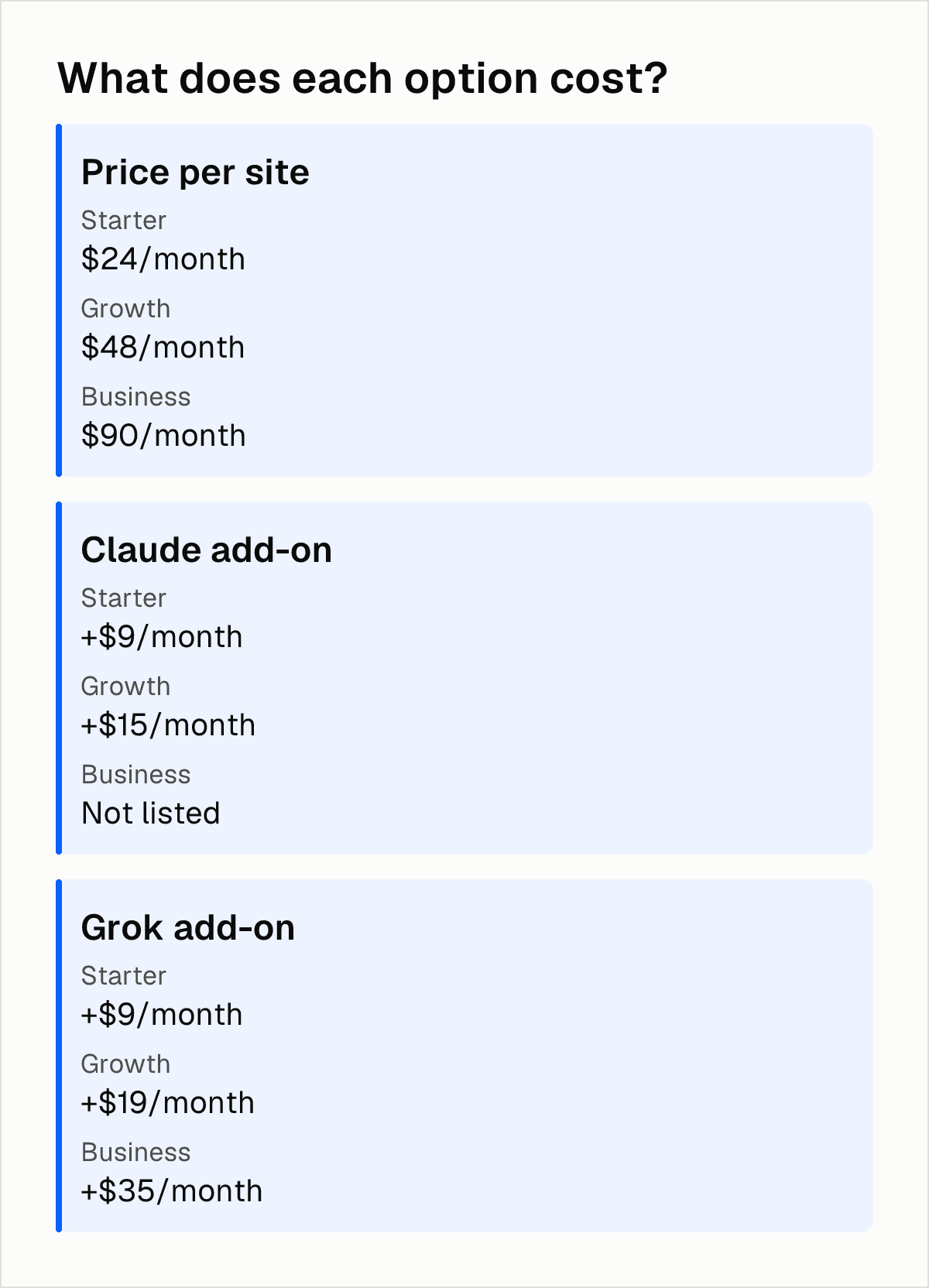
Hand-writing costs writer or in-house time, so the price depends on your team. For a managed service, compare what each plan includes. Citable starts at $24/month per site with articles included. Its plans:
| Citable plan | Price per site | Claude add-on | Grok add-on |
|---|---|---|---|
| Starter | $24/month | +$9/month | +$9/month |
| Growth | $48/month | +$15/month | +$19/month |
| Business | $90/month | Not listed | +$35/month |
For context, a third-party review lists Semrush's AI Visibility Toolkit at $99 per month per domain, plus $60 per month for each additional 50 prompts. Semrush's toolkit is built for monitoring, so that figure isn't a like-for-like comparison with a service that also writes and publishes. Semrush's guide, in turn, covers tactics and measurement but doesn't compare hand-writing with a managed service or cover CMS publishing workflows.
- Hand-written: the cost is hours, and it rises with every article.
- Weekly service: the cost is fixed per site, but you still pay in review time.
- Ask: what is included in the price: drafting, publishing, page fixes, measurement?
What changes for ecommerce and local businesses?
Product and business details must be right. For ecommerce, review AI-drafted product copy before it reaches your pages or feed. Specifications, prices and availability are the details most likely to be wrong, and a wrong price hurts whoever wrote it. Citable's article on how AI shopping tools read your product page covers what those tools read and what to fix.
For local businesses, the main risk is error in services, locations and opening hours. Checking those details by hand is usually faster than drafting them from scratch, so keep a person on that step even if a tool drafts the rest.
A short checklist for any vendor
- Named reviewer: one person checks each claim before publication.
- Sourced figures: every number links to a primary source with a date.
- Disclosure policy: written down, with real bylines only.
- Post-publication proof: a way to see whether AI tools cite or recommend your site.
If a vendor can't answer the first two clearly, skip the weekly volume plan.
Next steps
- Write down who will review claims before publication, and what they will check. Do this before you choose hand-writing or a service.
- Decide your disclosure and byline policy in one paragraph, and keep real names only.
- Confirm in Search Console that your site is included in Search generative AI features, then open the Generative AI performance report.
- Pick ten questions your buyers ask, run them in ChatGPT, Gemini and Perplexity, and record which sources get cited. Repeat monthly.
- To see what one assistant looks at, read Citable's piece on how Perplexity chooses its sources.
Frequently asked questions
Will Google penalize a site for publishing AI-written articles every week?
Not for using AI as such. Google's 2023 post says that automation used mainly to manipulate rankings breaks its spam policies, and that not all AI generation is spam. Publishing many pages without adding value is what puts a weekly pipeline at risk.
Do AI assistants cite AI-written or human-written articles more often?
The evidence conflicts. Graphite's research found most articles cited by ChatGPT and Perplexity were human-written, while a preprint reports AI-generated documents cited more often in Google AI Overviews. The vendor test from Otterly.ai covers one pair of pages, so it can't settle the question.
Should AI-written articles be labeled as AI-generated on my website?
Google's people-first guidance asks whether the use of AI is evident to visitors through disclosures or in other ways. It doesn't set a single labeling rule. Set a written policy, and never publish under invented authors, which Google treats as deception.
How do I know whether an AI tool is actually citing my site after publishing?
Ask the same set of questions in each assistant on a regular schedule and note which sources appear. For Google, the Generative AI performance report in Search Console shows results. A service such as Citable automates the same check across ChatGPT, Gemini, Perplexity, Claude, Grok and Google AI.
Sources
- Google Search's guidance about AI-generated content
- Google's Guide to Optimizing for Generative AI Features on Google Search
- Google publishes guide to optimizing for generative AI search (Semrush)
- Will AI-written content get your site penalized by Google? (Aliteq)
- Google's Spam Policies Now Apply to Attempts to Manipulate AI (Gizmodo)
- A Comparison of Human-Written Versus AI-Generated Text in Discussions at Educational Settings (Wiley)
- AI-written web pages haven't overwhelmed human-authored content (Axios)
- AI-generated content gets cited more than human content in Google AI Overviews (DEV Community)
- We Tested AI vs Human-Written Content (Otterly.ai)
- Generative Engine Optimization: A Practical Guide (Semrush)
- Creating Helpful, Reliable, People-First Content (Google)
- Google's New AI Search Guide Calls AEO And GEO 'Still SEO' (Search Engine Journal)
- Best Generative Engine Optimization (GEO) Tools 2026 (Nick Lafferty)
Keep reading
25 November 2026 · 9 min read
Why AI Doesn't Recommend Your Framer Studio, and What to Check
If AI skips your Framer studio, test whether crawlers can read your pages, then measure buyer questions and strengthen thin project evidence and unclear pages.
23 November 2026 · 7 min read
What Google AI Overviews are and how to measure them
Google AI Overviews are AI-generated summaries on some searches. You can't turn them off, but you can measure impressions, clicks and citations.
22 November 2026 · 9 min read
Content marketing explained: what it is, what it costs and how long it takes
What content marketing is, what budgets and timelines sources report, and what the evidence says about AI search citations.