Content marketing explained: what it is, what it costs and how long it takes
Citable · 22 November 2026 · 9 min read
Content marketing is the planning, creation and distribution of valuable, relevant and consistent content for a defined audience, with the aim of profitable customer action. Sources disagree on budgets, ROI and timelines, so check any figure before you use it. Results usually take months, and the evidence on AI search is still early.
Key takeaways:
- Budget guidance varies by source and mostly describes B2B companies. Start from your revenue goals instead of a copied percentage.
- ROI figures contradict each other. Trace each one to a primary study before you quote it.
- Expect first measurable signals within months. Significant results often take longer.
- The share of AI citations that come from brand-owned sources is disputed, so publishing alone does not decide whether AI cites you.
What is content marketing?
Two definitions are in common use. CMI's version describes a strategic approach to creating and distributing valuable, relevant and consistent content for a clearly defined audience, aimed at profitable customer action. Semrush defines it more loosely, as planning, creating and sharing valuable content to attract and engage a specific audience.
CMI ties content to customer action. Semrush stops at attraction and engagement. Use the stricter definition to judge a plan, because it forces the question of what the content should make people do.
Mailchimp goes further and argues that authoritative content helps generative engines trust, cite and recommend a brand. That is a vendor claim, not independent data, so test it against the evidence below.
Does content marketing still work when AI gives the answer?
An arXiv study of 149,912 AI citations found that about 59% of cited pages were content, usually articles. The other 41% were homepages, product pages or other non-content pages. Listicles, meaning ranked best-of roundups, were the largest single format, at 35.7% of content citations.
The same study found that 75.2% of citations came from corporate or third-party brand pages. A brand's own site is only part of what AI engines cite.
Sources disagree on how much comes from material a brand controls. Ziptie reports that Yext's analysis of 6.8 million citations puts brand-controlled or brand-influenced sources at 86% across ChatGPT, Gemini and Perplexity. Convert relays Omniscient's January 2026 analysis, which says branded queries pull 77% of their citations from sources a brand does not own.
Until that split is settled, treat articles as one input among several. Reviews, third-party mentions and your own pages all feed AI answers. Our guides on what GEO and AEO are and on optimizing content for AI search go deeper on how that works.
The engines also differ. Search Engine Land reports that ChatGPT and Google AI Overviews cite around three to four brands per answer on average. Perplexity and, to some extent, Gemini give mid-tier or niche brands more chances to be mentioned.
How much should you spend on content?
The sources give ranges, not a single number:
| Source | Figure | Who it describes |
|---|---|---|
| ZoomInfo, citing CMI 2025 | Average 26% of total marketing budget; most successful 40% | B2B organizations |
| AirOps | 10–15% of total marketing budget | B2B companies, typically |
| B2B Content Show | 10–20%; B2B SaaS can reach 25–30% | Most B2B companies |
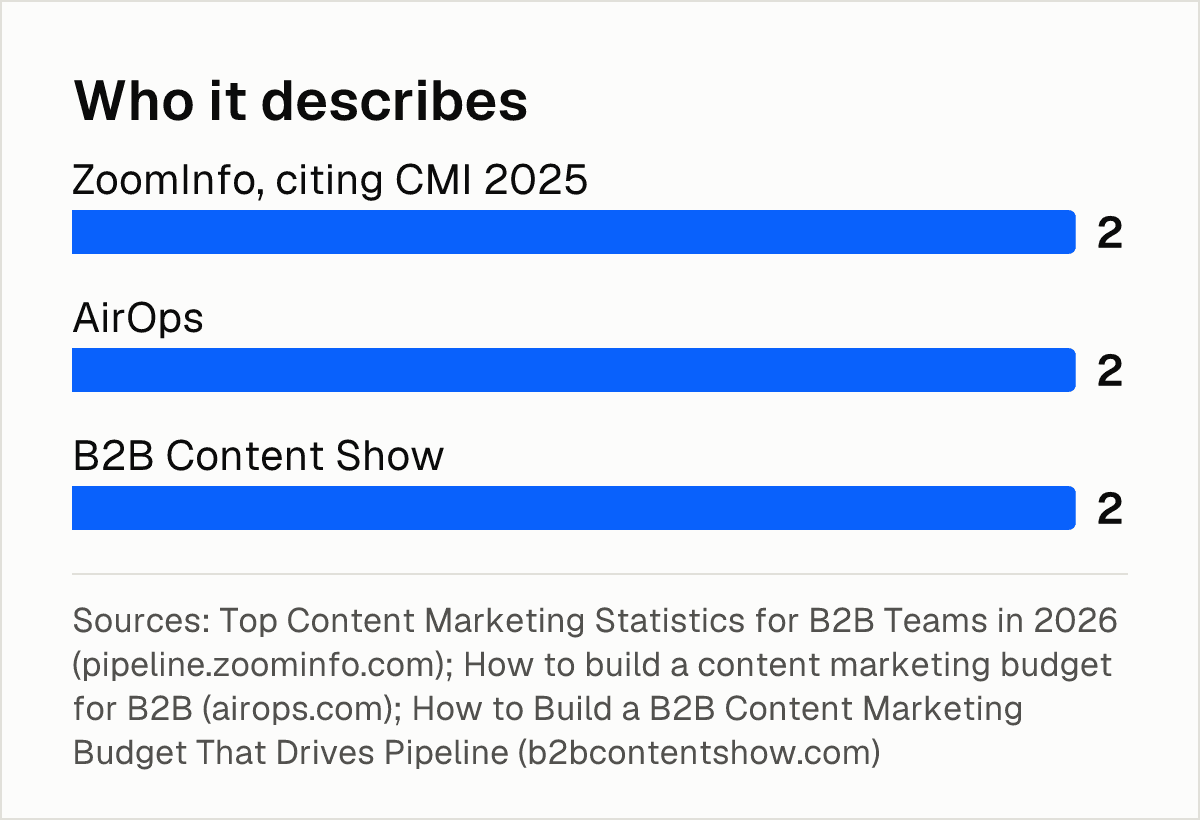
AirOps and B2B Content Show are not primary studies, and all three describe B2B companies. If you run an ecommerce brand or a local business, none of them is a direct benchmark for you.
The clearest primary signal is about direction. In CMI's 2025 B2B benchmark, 46% of marketers expected their content budget to increase in 2025, 41% expected it to stay the same and 8% expected a decrease.
For a small team, start from the revenue you need content to support. Work out the pipeline it should generate, set a budget that fits, and review it after a fixed period.
What return can you expect from content marketing?
Secondary blogs contradict each other. Marketful reports a median B2B content marketing ROI of 287% over 36 months across 312 companies, or $2.87 of revenue per $1 of content spend. BizIQ reports an average of $7.65 returned per $1 spent in 2026, which it attributes to Revenue Memo, another secondary source. No primary study was confirmed for either figure.
A widely repeated claim says content generates roughly 3x more leads than outbound at about 62% lower cost, attributed to DemandMetric. Techcognate is one of many secondary pages that repeat it. Check the original DemandMetric study before you quote the claim.
Measure your own return against your own pipeline, using metrics you chose before you started. To see whether AI assistants send you visitors, set up tracking in GA4.
How long does content marketing take to show results?
The estimates conflict. Marketing Insider Group, an agency, says content marketing takes around four to five months to show measurable results. Clearvoice puts significant results later:
"Multiple studies state that content marketing may take between six to twelve months to get significant results." — Clearvoice
The channel also changes the timeline. Kyber Consulting says on-site content takes at least six months to show results, and off-site content six to twelve months.
Plan for first measurable signals within months and significant results later. These are estimates from agencies and consultancies, not guarantees.
Why doesn't more content mean better results?
CMI's 2026 figures, relayed by Christopher Olivier Consulting, show a gap: 87% of marketers report better productivity from AI, but only 39% see improved content performance. AI has raised output more than results.
The same source reports that 97% of B2B marketers have a strategy, yet only 11% rate it excellent, citing Semrush. Having a plan is common. A plan you would call excellent is rare.
Searchlab reports, citing CMI 2026, that companies with a documented content strategy are 3.5x more successful than those without one. This is a correlation from a secondary aggregator, so it does not prove that documenting a strategy causes better results.
A documented plan and measurement look more useful than raw volume. If you use AI to draft, build the brief and check the facts before anything goes live.
How do you check a content marketing claim, agency or tool?
Before you use a figure, ask four questions:
- Origin: Is the number from a primary study or a secondary page?
- Year: What period does it cover?
- Company type: Does it describe a business like yours?
- Method: How was it measured, and by whom?
For an agency or tool, ask three more:
- Measurement: How do they measure results, and over what period?
- AI answers: Do they track AI answers as well as rankings?
- Link building: How do they earn links, and do they use link schemes?
AI answers are unstable, so a single check is not enough. ZS reports that AI Overview content changes 70% of the time for the same query, and nearly half of citations are replaced on each regeneration. Measure repeatedly, over weeks.
Apply the same questions to every option, including in-house work.
Next steps
- Define the audience and the action: Write down who you want to reach and what they should do after reading.
- Set a budget range: Compare at least two sources, and check which company type each one describes.
- Pick two or three metrics: Choose them before you publish anything, and set a review date.
- Run your own AI check: Ask ChatGPT, Gemini and Perplexity your buyers' questions several times and note which brands appear.
- Automate the weekly check if you want: Citable measures whether ChatGPT, Gemini, Perplexity, Claude, Grok and Google AI cite or recommend your site, and starts at $24/month with articles included. Here is how the manual version works: checking whether ChatGPT recommends your brand.
Frequently asked questions
What is content marketing, in plain terms?
It is creating and sharing useful content for a specific audience so that some of them become customers. CMI frames it as valuable, relevant and consistent content for a clearly defined audience, aimed at profitable customer action. Semrush's simpler definition stops at attracting and engaging that audience.
How much should a small business spend on content marketing?
The figures in circulation describe B2B companies. AirOps says 10–15% of total marketing budget, B2B Content Show says 10–20%, and CMI's 2025 data as reported by ZoomInfo averages 26%. Start from the revenue you need content to support, set a budget that fits, and review it after a fixed period.
How long does content marketing take to show results?
Estimates range from four to five months for measurable results (Marketing Insider Group) to six to twelve months for significant ones (Clearvoice). Kyber Consulting says on-site content takes at least six months and off-site content six to twelve. Treat these as planning ranges.
Does content marketing still work in the age of AI search?
Content is a large share of what AI engines cite: in the arXiv study of 149,912 citations, about 59% were content pages. Sources disagree on how much comes from brand-owned material, with Yext at 86% brand-controlled or influenced and Omniscient at 77% from sources a brand does not own. The evidence is still early.
Sources
- What Is Content Marketing? (CMI)
- What Is Content Marketing? [Simple Definition + Starter Guide] (Semrush)
- What is Content Marketing and does it still work in 2026? (Mailchimp)
- Generative Engine Optimization at Scale: Measuring Brand Visibility Across AI Search Engines (arXiv)
- AI's Brand Citation Algorithm (Ziptie)
- AI Search Optimization Strategies (Convert)
- How to get cited by AI: SEO insights from 8,000 AI citations (Search Engine Land)
- Top Content Marketing Statistics for B2B Teams in 2026 (ZoomInfo)
- How to build a content marketing budget for B2B (AirOps)
- How to Build a B2B Content Marketing Budget That Drives Pipeline (B2B Content Show)
- B2B Content Marketing: 2025 Benchmarks & Trends (CMI)
- 47 Content Marketing Statistics for 2026 (Marketful)
- Content Marketing Statistics 2026: ROI, Blogging & Video Data (BizIQ)
- 90+ Content Marketing Statistics 2026 (Techcognate)
- How Long Does It Take for Content Marketing to Actually Work? (Marketing Insider Group)
- Content Marketing Results Explained: When to Expect Results (Clearvoice)
- How Long Does it Take to See Results from Content Marketing? (Kyber Consulting)
- Content Marketing Statistics 2026: Verified Data (Christopher Olivier Consulting)
- Content Marketing Statistics 2026 (Searchlab)
- When your customers ask AI, is your brand showing in GEO (ZS)
Keep reading
25 November 2026 · 9 min read
Why AI Doesn't Recommend Your Framer Studio, and What to Check
If AI skips your Framer studio, test whether crawlers can read your pages, then measure buyer questions and strengthen thin project evidence and unclear pages.
24 November 2026 · 11 min read
Hand-written or AI-drafted: six checks for AI citations
Hand-writing or a weekly AI service? Neither wins by default: six checks on review, sourcing, disclosure and measurement decide which fits you.
23 November 2026 · 7 min read
What Google AI Overviews are and how to measure them
Google AI Overviews are AI-generated summaries on some searches. You can't turn them off, but you can measure impressions, clicks and citations.