Does Your Brand Name Affect AI Recommendations?
Citable · 8 November 2026 · 9 min read
Sometimes, and the evidence is narrower than it looks. A controlled preprint found that a well-known real brand was recommended in every trial when only the name differed, while fictional names never were. That edge vanished with a small rating gap, and the study is not peer-reviewed.
The essentials:
- Name-only evidence: it comes from one non-peer-reviewed preprint on one product category.
- Recognition is not recommendation: large, established brands are often left out of category prompts entirely.
- Shared names: a short or common name can split a brand across two entities.
- Web mentions: Ahrefs' 75,000-brand study found they correlate 0.664 with AI Overview brand visibility, the strongest off-site factor it measured, though that is correlation, not proof of cause.
- Cost: no study prices the name effect. Checking it costs time; ongoing tracking is a monthly fee per site.
Does the name itself change AI recommendations?
The clearest test so far is a controlled preprint on skincare products. All products had identical specifications, so the brand name was the only difference between them. The study used three LLMs and 670 valid trials.

The real, well-known brand was recommended in every trial, reaching the theoretical maximum score (IAI = 10.0). Fictional brands were never recommended.
The authors read this as selection by recognition, not evaluation:
"The LLM does not evaluate the products on their specs; it simply picks the name it recognizes." (the preprint's authors, arXiv preprint)
The advantage has a ceiling. According to the HTML version of the preprint, the dominance disappears with a +0.1-star rating advantage for a competitor.
The scope is narrow. The study is not peer-reviewed, covers one product category, and uses fictional brands as its control. It shows a mechanism in one setup, not a rule for every brand in every market.
Does being well known guarantee a place in the answer?
No. A 2026 arXiv study, not peer-reviewed, found very limited evidence of the popularity bias seen in traditional recommender systems. Salient brands are sometimes recommended prominently, but the pattern varies widely by category.
In the same study, category-only prompts across six LLMs often left out large, established brands entirely. Market presence does not guarantee inclusion.
Prompt wording matters too. A 2026 arXiv study on brand category ownership found that comparison prompts lower the odds a brand is named (odds ratio 0.73), while exploration prompts raise them (odds ratio 1.70).
Search fame also translates weakly. Ahrefs' 75K study found that branded traffic has a weak correlation (0.274) with AI Overview mentions, according to Analyze.
A name the AI knows can still be missing from the answer. If you test one prompt, you may be measuring the wording rather than your brand.
Can a shared or common name split your brand?
Search Engine Land describes a brand name as a label that can point to one or several entities. An AI system must first work out which company is meant before it can recommend it.
The risk is highest for short or common names, acronyms, rebrands, and names shared with established organizations.
The article's clearest case is a UK activewear brand that shares its name with a fintech company. The brand appeared in none of the athleisure or sportswear recommendation responses tested, even though the LLMs categorized it correctly once the apparel entity was specified.
The author is careful: the case is observational and does not establish that the Knowledge Graph mismatch caused the zero recommendation rate. Treat it as a warning sign, not a measured cause.
Sharing a name is not, by itself, entity hijacking. Search Engine Land lists what can make two same-name entities distinguishable:
- A distinctive website
- Consistent organizational information
- Established relationships with identifiable people and products
- Authoritative third-party references
- A coherent category footprint
For the technical side of consistent organizational information, see Citable's guide to structured data for AI search.
Do web mentions of the name matter more than the name?
Ahrefs' 75,000-brand study, from May 2025, measured which factors correlate with brand visibility in AI Overviews. Three off-site factors led the list:
| Off-site factor | Correlation with AI Overview brand visibility |
|---|
Branded web mentions were the strongest factor the study measured. According to LSEO's summary, a mention counted the brand name wherever it appeared on the web, whether or not it was linked.
These are correlations. Ahrefs' own caveat, as LSEO reports it, is that the finding is correlation, not causation. Mentions may simply track brands that are already visible.
A separate Seer Interactive analysis of 541,213 responses, as reported by BrandMentions, found a citation rate of 53.1% when the brand was mentioned in the answer and 10.6% when it was not. The same page reports a Seer study of 10,000 questions in which brand search volume correlated 0.18 with AI mentions, a real but modest relationship.
Taken together, these studies treat the name as one input among several, and they describe correlations rather than levers with proven effect.
How do you test your own name?
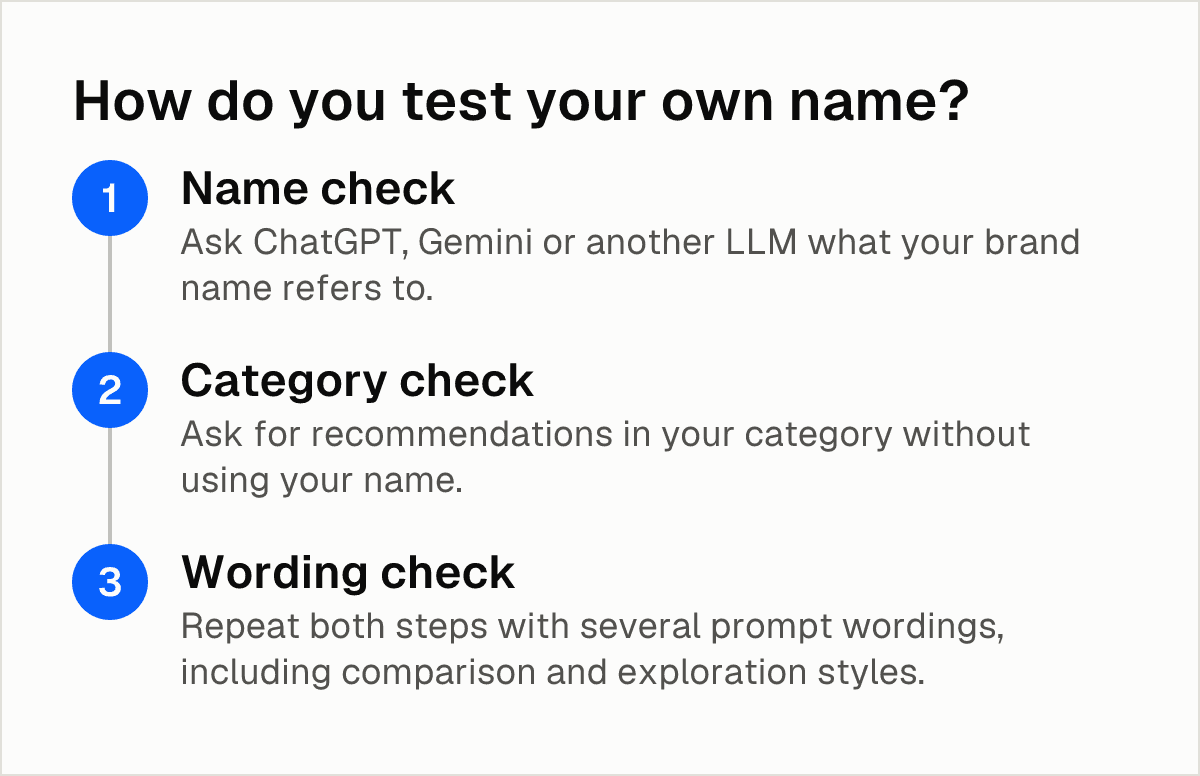
Start with the name, then test the category without it:
- Name check: ask ChatGPT, Gemini or another LLM what your brand name refers to. A wrong or mixed answer is a sign of entity confusion to investigate, not proof of the cause.
- Category check: ask for recommendations in your category without using your name.
- Wording check: repeat both steps with several prompt wordings, including comparison and exploration styles.
One prompt cannot show inclusion, as the odds ratios above make clear. Compare answers across wordings before concluding anything. For a fuller walk-through, read how to check if ChatGPT recommends your brand. For the measurement side, see how to measure brand visibility in ChatGPT.
What does it cost to find out whether your name is the problem?
No study puts a price on the name effect. The research measures correlations and odds, not costs, and no study cited here quantifies what a rename costs in AI visibility. Your budget depends on what you do about the result.
Three things drive the cost:
- Manual checking: a handful of prompts, repeated weekly, costs only time.
- Tracking scope: the number of sites and AI tools you monitor.
- Action: whether you only measure, or also publish articles and page fixes.
If you want a tool instead of a spreadsheet, Citable charges per site per month:
Citable measures whether ChatGPT, Gemini, Perplexity, Claude, Grok and Google AI cite or recommend a site, and works out why competitors are picked instead. It then writes sourced articles and makes page fixes, publishing them to your CMS. Starter includes articles. The tool shows what AI says about your name on your own data; it cannot tell you in advance what a rename would cost or gain.
A practical budget is to run the free manual test first. If it shows confusion or omission, decide whether you need ongoing tracking and fixes.
What is still unknown?
The strongest name-specific evidence is one preprint with fictional brands and one product category. It does not generalize to every industry.
Most correlations above come from the Ahrefs study, which measured AI Overviews rather than every AI tool. A correlation with AI Overviews says little about how ChatGPT or Perplexity treat the same name.
Country of origin is another open question. A 2024 arXiv study found that LLMs tend to associate global brands with positive attributes, and that country-of-origin effects can favor local brands in some contexts. That finding does not measure any specific market.
How long AI tools take to recognize a new name, and what a rename does to visibility, remain unmeasured in the studies above. Treat a rename or a common word in your name as a risk to check on your own data, not a guaranteed loss.
Next steps
- Ask three LLMs what your brand name refers to, and write down every answer that confuses you with another company.
- Ask for recommendations in your category without your name, using at least one comparison prompt and one exploration prompt, and repeat the test next week.
- Fix the signals that separate you from a same-name entity: a distinctive website, consistent organization details everywhere, and third-party references that mention you by name.
- Count where your brand is mentioned on the web, linked or not, and note which sites are missing.
- If you want this measured weekly across ChatGPT, Gemini, Perplexity, Claude, Grok and Google AI, Citable does it in four steps: measure, understand, act and check.
Frequently asked questions
Does a brand name that is a common English word hurt AI recommendations?
It can raise the risk of entity confusion. Search Engine Land says brands with short or common names, acronyms, rebrands, or names shared with established organizations are especially vulnerable. No study measures the size of that penalty.
Will changing my brand name reset my AI visibility?
No study cited here measures the effect of a rename on AI visibility. Search Engine Land names rebrands as a source of entity confusion, so keep your site, organization details and third-party references consistent through a change.
How do I check whether ChatGPT or Gemini confuses my brand with another company?
Ask what your brand name refers to, then ask for category recommendations without the name, and repeat with different wordings. A wrong company in the first answer, or absence from the second, points to confusion. It does not prove the cause.
Do brand mentions without links help AI recommend a company?
They count in the best-known data. In Ahrefs' study, branded web mentions counted whether or not they were linked, and they correlated 0.664 with AI Overview visibility. That is a correlation, not proof that mentions cause recommendations.
Sources
- Incumbent Advantage: Brand Bias and Cognitive Manipulation Dynamics in LLM Recommendation Systems (PDF)
- Incumbent Advantage: Brand Bias and Cognitive Manipulation Dynamics in LLM Recommendation Systems (HTML)
- Evaluating Brand Retrieval and Ranking in Large Language Model Recommendations
- Who Owns the AI Recommendation? A Multi-Industry Empirical Map of Brand Category Ownership Across Large Language Models
- How entity confusion can hurt your brand's AI visibility
- An Analysis of AI Overview Brand Visibility Factors (75K Brands Studied)
- What Ahrefs' 75K-Brand Study Says About AI Visibility
- AI Overview Brand Visibility Factors: Impact on AI Search
- Do Brand Mentions Really Influence AI Visibility? The 2026 Evidence
- "Global is Good, Local is Bad?": Understanding Brand Bias in LLMs
Keep reading
7 November 2026 · 7 min read
GEO guide: what the evidence supports and how to test it
GEO is making content easier for AI engines to retrieve and cite. The evidence is real but narrow, and results vary by engine. Here is what holds up and how…
6 November 2026 · 9 min read
Step by step: how to monitor competitors in AI search
Build a fixed set of buyer prompts, run them on the AI engines your buyers use, and track share of voice and cited sources over time to monitor competitors.
5 November 2026 · 7 min read
FAQ pages that AI assistants quote: what the evidence shows
Write each FAQ heading as the question a buyer types and answer it in one or two standalone sentences. Schema alone showed no citation lift in tests.