GEO guide: what the evidence supports and how to test it
Citable · 7 November 2026 · 7 min read
Generative Engine Optimization (GEO) is the practice of making a site's content more likely to be retrieved, cited and accurately reflected in AI-generated answers. The evidence is real but narrower than most guides suggest: the best-known gains come from controlled benchmarks, and results vary by engine and query type. The safest approach is a relevant, verifiable, clearly structured and technically retrievable page, measured over time.
- The "40% visibility gain" comes from the original GEO paper's own benchmark, not from live search traffic.
- Keyword stuffing showed little to no benefit in that study. Verifiable, attributed evidence is the criterion that holds up.
- Engines differ: a 2026 critical survey cites an audit finding that 53% of domains cited by Google AI Overviews are not in the organic top 10.
- Test 10 to 20 buyer prompts, repeat them on different days, and change one thing at a time.
Where does the term GEO come from?
The term comes from a 2024 KDD paper, which presented GEO as a new paradigm for helping content creators improve their visibility in generative engine responses.

GEO is about how AI answers select, cite and reuse sources. It is not a rename of SEO. Many guides use AEO (answer engine optimization) and "AI SEO" for overlapping work. Citable's explainer on GEO, AEO and how they differ from SEO sets out the differences.
What does the "40% visibility gain" actually show?
The original paper says optimization can boost visibility by up to 40% in generative engine responses, measured on its own benchmark.
"Through rigorous evaluation, we demonstrate that GEO can boost visibility by up to 40% in generative engine responses." — the authors of the GEO paper
A critical survey of 45 GEO studies says the figure is often recast as a general promise. It describes a relative gain in a simulator where five documents are already in context, so it does not show higher retrieval or clicks.
In the same benchmark, the best-performing methods, including Quotation Addition and Statistics Addition, gave the largest gains, according to the original paper:
| Figure | Metric | What it shows |
|---|---|---|
| Up to 40% | Visibility in generative engine responses | A relative gain in a simulator with five documents in context |
| 41% | Position-Adjusted Word Count | A gain on the paper's own metric |
| 28% | Subjective Impression | A gain on the paper's own metric |
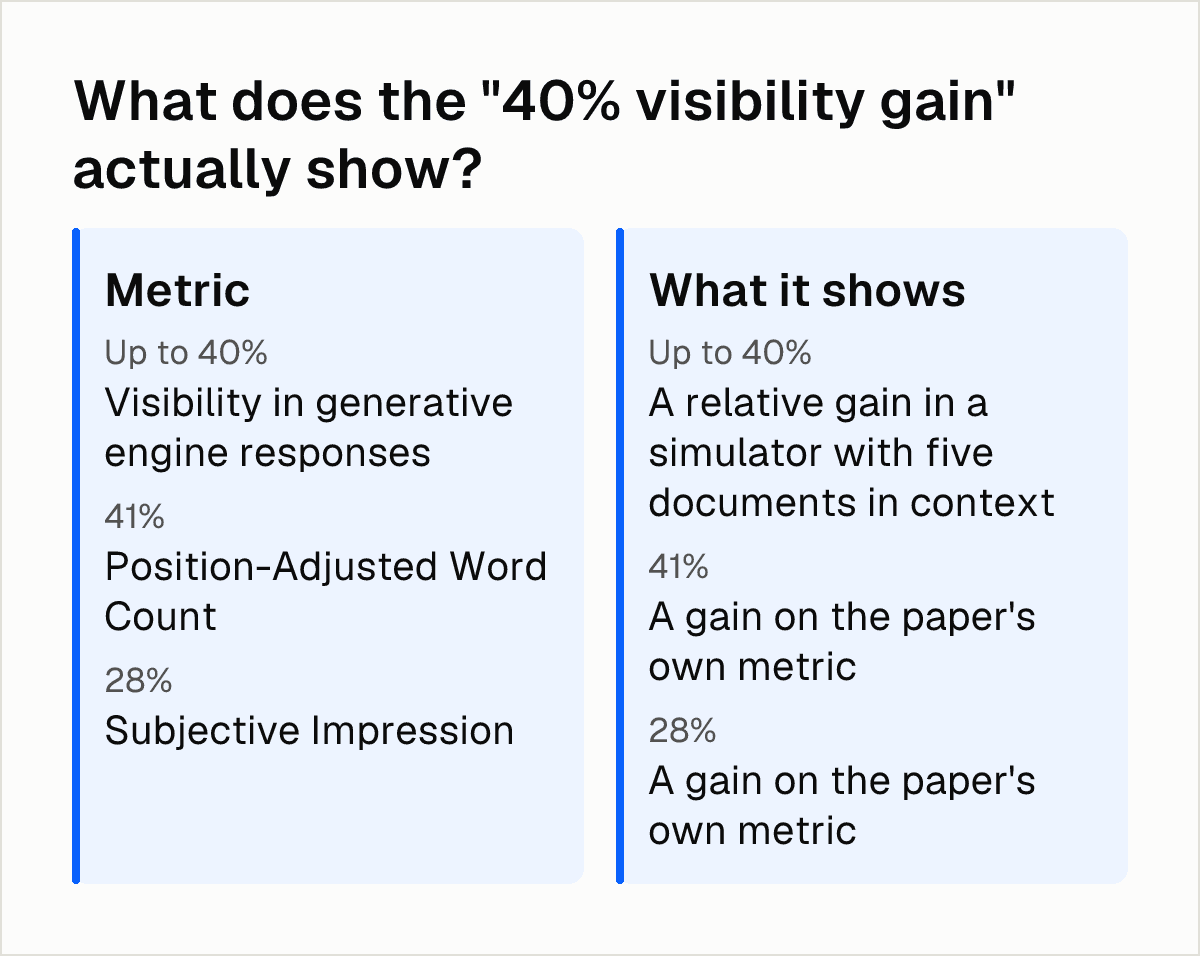
None of these figures measures real traffic. A 2026 survey of 45 GEO studies says the 40% figure is often presented as a general promise, but it does not show higher retrieval or clicks. When a vendor quotes the 40% number, check the metric, the setup and whether the test covered live search results.
What transfers from SEO, and what does not?
Keyword stuffing, the classic SEO tactic, offered little to no improvement in the original study. SEO habits do not transfer directly.
The original GEO study found that lower-ranked websites benefited more from GEO than top-ranked ones. Cite Sources gave a 115.1% visibility increase to a site ranked fifth in search results. That is one benchmark, not a general rule.
Adding statistics is not automatically good. The 2026 survey warns that a fabricated statistic may increase reuse while degrading epistemic quality. The criterion is verifiable, attributed evidence.
Why do results change by engine and query?
There is no global GEO ranking. The survey says the field found low overlap in sources between engines, and that visibility is indexed by engine and surface.
Google AI Overviews often cite domains outside the organic top results. A ranking report alone will not tell you who gets cited. For how Google's newer surface differs, see Citable's explainer on Google AI Mode.
Query form matters too. In a 2026 longitudinal study cited by the survey, the AI Overview activation rate was 13.7% overall but 64.7% for questions. Test with the questions buyers actually ask.
Real-engine tests need care. The original paper's Perplexity test used texts uploaded as files rather than pages retrieved organically, so it does not test crawling or ranking in production.
How much evidence backs each tactic?
The survey's best-supported advice is conservative: publish a relevant, comprehensive, verifiable, clearly structured and technically retrievable page, then measure retrieval, citation and fidelity separately.
Third-party mentions may matter. A 2025 preprint cited in the survey found earned media overrepresented, but the survey notes it is observational and does not prove that outside coverage causes recommendations.
Clicks are the weakest link. Evidence that AI citations lead to clicks, conversions or revenue is very thin. The survey calls a log-based effect it cites suggestive rather than causally established.
Popular tactics may also lose value. A benchmark cited by the survey reports that gains decline as adoption increases, approaching a zero-sum game.
How do you test your own AI visibility?
Run a simple test before you spend on any change.
- Pick the prompts: choose 10 to 20 prompts a buyer would type, including question forms.
- Record the sources: note which sources each engine cites for each prompt, and repeat on different days.
- Read the pattern: one run tells you little. Citable's guide on checking whether ChatGPT recommends your brand explains why one prompt is not enough.
- Compare with competitors: note who is cited for the same prompts and what their pages contain.
- Change one thing: add a sourced quote or fix one page's structure, then re-test over several weeks with the same prompts, engines and dates.
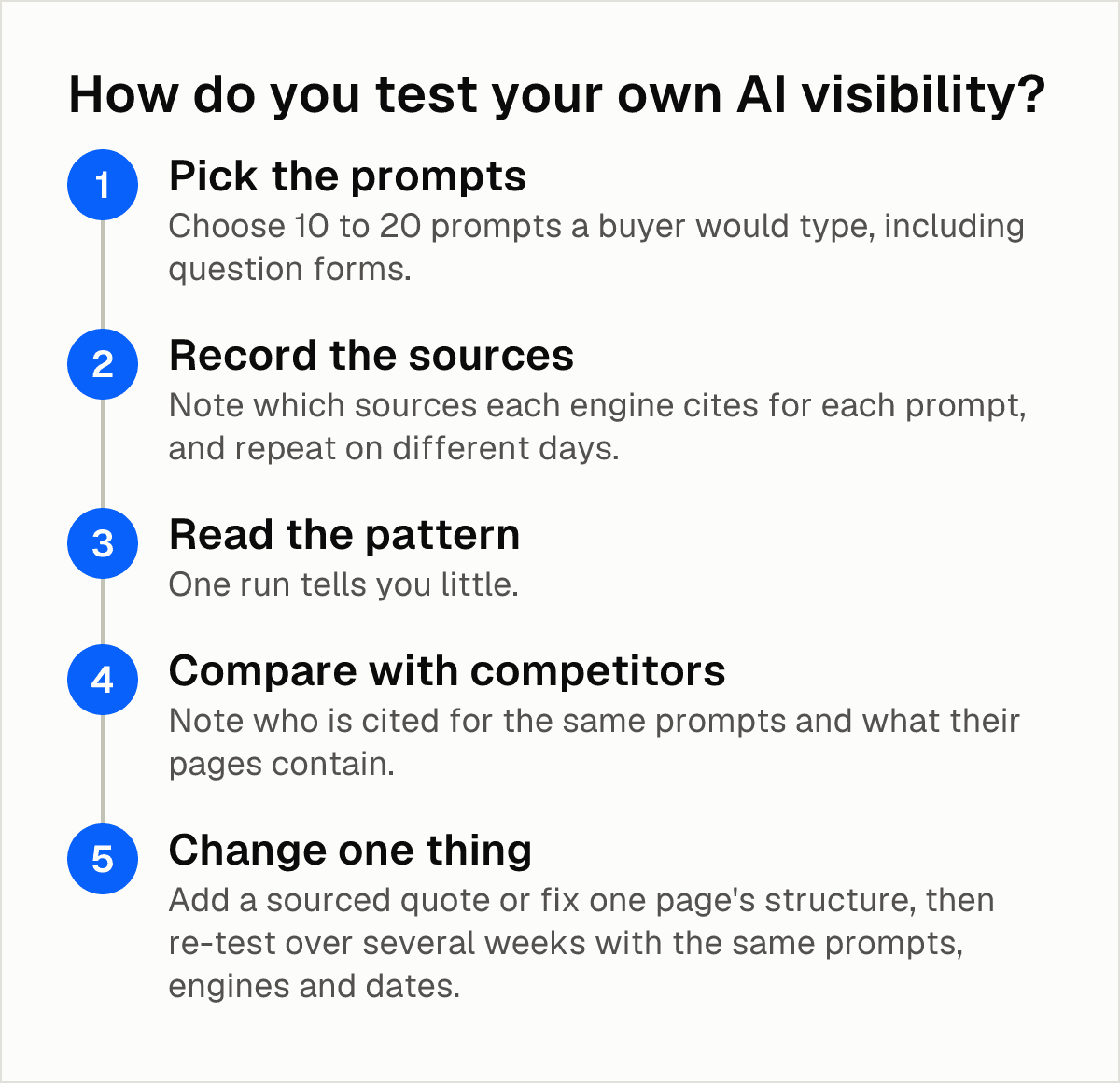
One engine or surface does not represent the whole AI ecosystem, which is why the survey recommends measuring retrieval, citation and fidelity separately.
Next steps
- Write down 10 to 20 buyer prompts, including questions, and save them as your fixed test set.
- Record which sources each engine cites for those prompts, on at least two different days.
- Pick one page and make it more relevant, verifiable and clearly structured. Attribute every figure to a source you have checked.
- Re-run the same prompts after several weeks and compare citations, not just mentions.
- If you want this measured weekly, Citable checks whether ChatGPT, Gemini, Perplexity, Claude, Grok and Google AI cite a site, then explains why competitors are picked instead; see how Citable works.
Frequently asked questions
What is the difference between GEO, AEO and traditional SEO?
SEO targets rankings in search results. GEO targets how AI answers retrieve, cite and reuse your content. AEO is often used for overlapping work. In the original study, keyword stuffing, a classic SEO tactic, showed little to no improvement.
Do AI tools prefer quotes and statistics, and what happens if those numbers are wrong?
In the original benchmark, Quotation Addition and Statistics Addition were among the best-performing methods. The 2026 survey warns that a fabricated statistic may increase reuse while degrading epistemic quality. Use only verifiable, attributed figures.
Is GEO worth it for a small business or an ecommerce store?
The original study found that lower-ranked websites benefited more from GEO than top-ranked ones, though that is one benchmark. The evidence linking AI citations to clicks or revenue is thin, so start with low-cost page improvements and measure.
Does ranking in Google guarantee citation in AI answers?
No. An audit cited in the critical survey found that 53% of domains cited by Google AI Overviews do not appear in the organic top 10. Sources also overlap little between engines.
Sources
Keep reading
6 November 2026 · 9 min read
Step by step: how to monitor competitors in AI search
Build a fixed set of buyer prompts, run them on the AI engines your buyers use, and track share of voice and cited sources over time to monitor competitors.
5 November 2026 · 7 min read
FAQ pages that AI assistants quote: what the evidence shows
Write each FAQ heading as the question a buyer types and answer it in one or two standalone sentences. Schema alone showed no citation lift in tests.
4 November 2026 · 7 min read
Does Schema Markup Help in AI Search? What the Google and Ahrefs Data Show
Schema markup is not a proven lever for AI citations: Google says it isn't required and an Ahrefs test found no major uplift. Here is what to do.