Step by step: how to monitor competitors in AI search
Citable · 6 November 2026 · 9 min read
To monitor competitors in AI search, build a fixed set of buyer prompts, run them across the AI engines your buyers actually use, and repeat them over time. A set of roughly 10 to 15 prompts is a workable size for a spreadsheet, according to Shadow's measurement guide. Track shares, cited sources and patterns across runs, not exact positions, because AI answers change between searches.
In short:
- Keep one frozen prompt set that mixes comparisons, category questions and problem-solution questions.
- Track every engine your buyers use, in the locations and languages they search from.
- Run each prompt on a schedule and report share of voice and citation share.
- For each competitor that appears when you don't, list the pages the engines cite, fix the gap on your own pages and measure again.
What do you need before you start?
You need four things: a competitor list, a buyer profile, a list of engines and a list of markets.
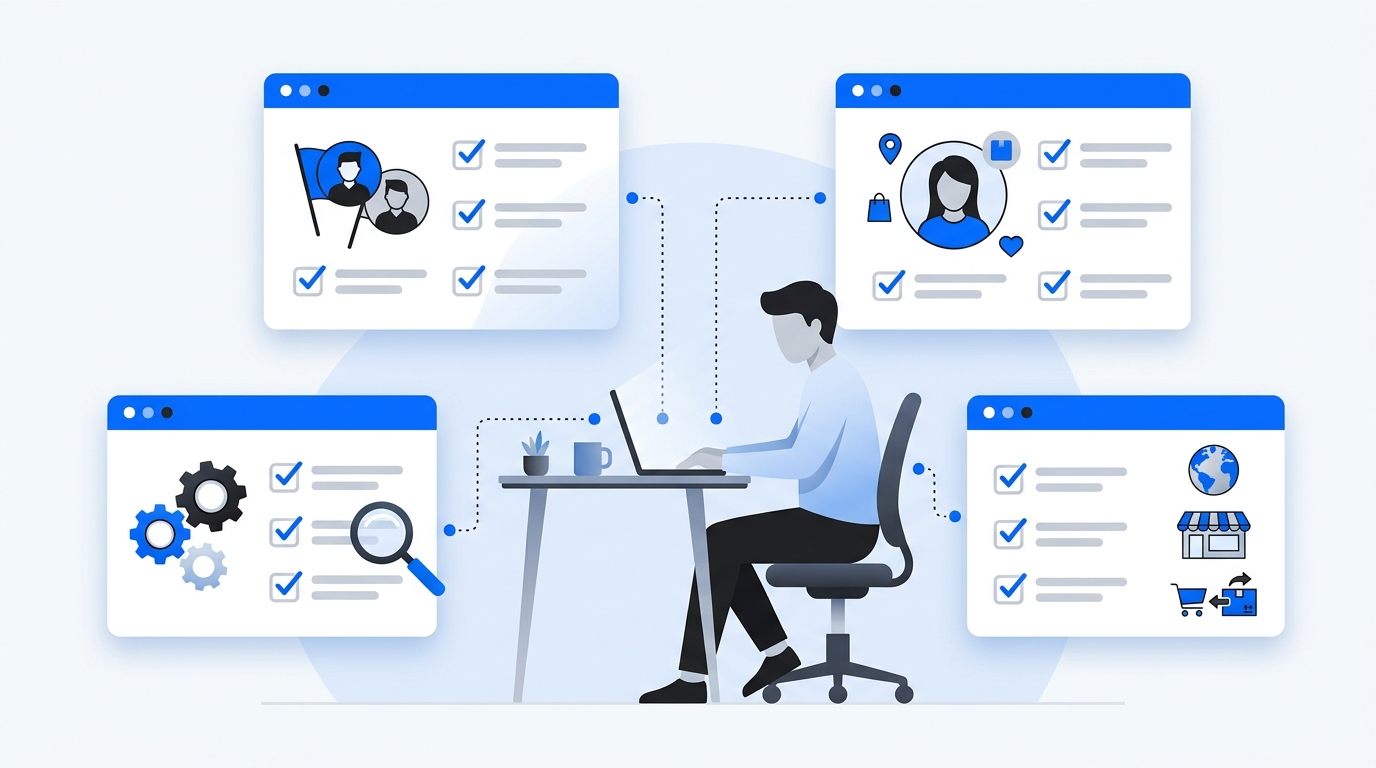
Monitoring works best at the prompt level. Dageno's guide says one high-intent question can show exactly where AI systems mention competitors and ignore your brand. A full dashboard is not the starting point.
- Competitors: write down the ones you already know. The monitoring will surface others.
- Buyer profile: role, location and language. A prompt written for a real buyer beats a generic one.
- Engines: list every platform your audience uses. Nightwatch notes that a strong ChatGPT score does not mean you are visible across AI search, because each platform has its own citation logic and audience.
- Markets: decide which cities, countries and languages you will test. A study covered by SME Street changed only the buyer's city, and the two results had no brand names in common.
If you want a baseline for your own brand first, Citable's free AI visibility report checks whether ChatGPT mentions your site.
How do you build the prompt set?
Write the prompts, then freeze them. Each one should be something a real buyer would type.
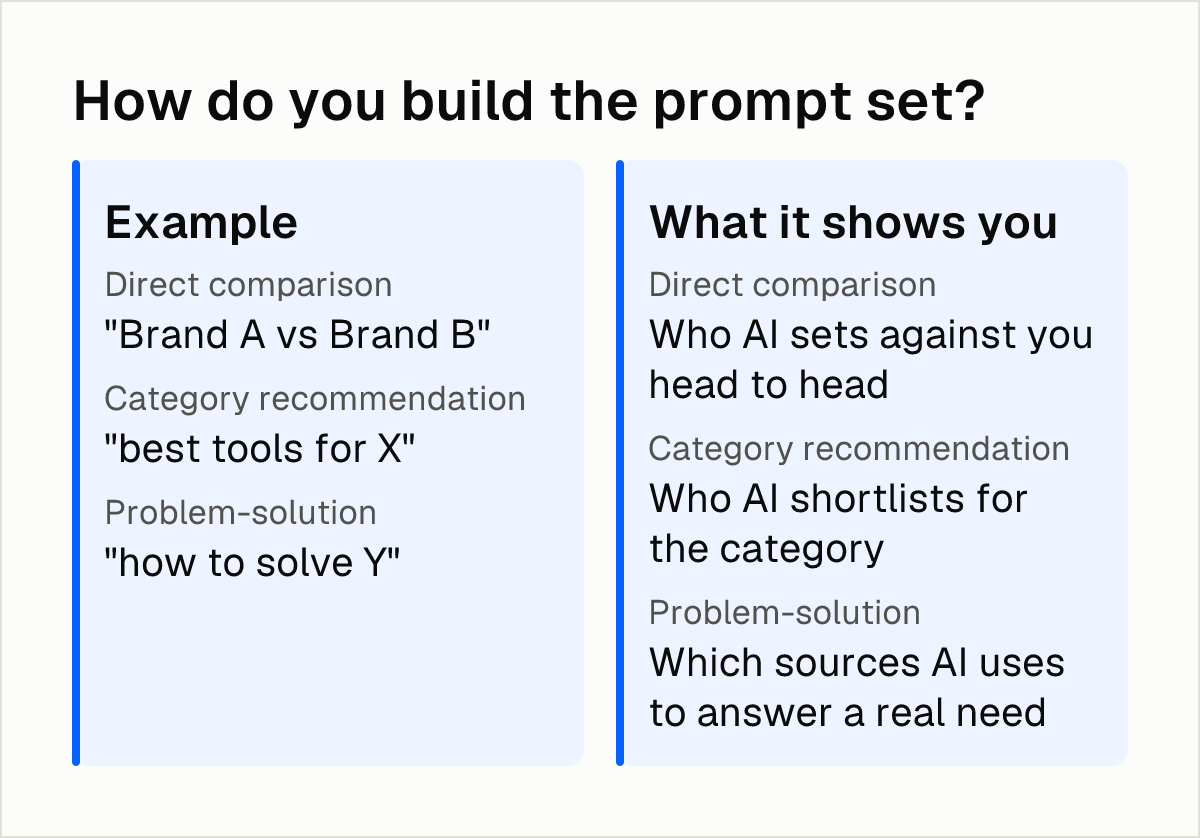
Siftly's 2026 guide recommends mixing three query types:
| Query type | Example | What it shows you |
|---|---|---|
| Direct comparison | "Brand A vs Brand B" | Who AI sets against you head to head |
| Category recommendation | "best tools for X" | Who AI shortlists for the category |
| Problem-solution | "how to solve Y" | Which sources AI uses to answer a real need |
- What to do: write 10 to 15 prompts across the three types. Include broad category prompts and narrow use-case prompts. Trysight says broad prompts surface different competitors than narrow ones, so you need both.
- How you know it's right: each query type appears at least once, several prompts are narrow use cases, and the wording does not change after the first run.
- Typical mistake: using only broad "best tools" prompts, or rewording prompts between runs. Either one makes trends unreadable.
A spreadsheet is enough at this size. Shadow says manual tracking works for small prompt sets but does not scale beyond 10 to 15 queries. Past that, move the tracking into a tool.
How do you run the prompts?
Run every prompt on each chosen engine in the same way. Log the full answer, the brands named and the sources cited. Then repeat on a regular schedule.
One answer is never enough. SparkToro tested repeated prompts and found how far lists vary:
"there's a <1 in 100 chance that ChatGPT or Google's AI, if asked 100X, will give you the same list of brands in any two responses." — SparkToro, in its AI recommendations study
That does not make the data useless. A Conductor study based on 14,000 API calls describes AI recommendations as predictably inconsistent, with query intent, not industry size, as the main predictor. You track the pattern across runs.
- What to do: run each prompt several times per engine, per location, on a fixed schedule.
- How you know it's right: your log holds multiple runs per prompt, and you can see which brands recur.
- Typical mistake: treating a single response as the truth.
Citable's guide to checking whether ChatGPT recommends your brand explains why one prompt is not enough.
Which metrics should you record?
Record the same metrics for each competitor every time. Dageno lists the core ones:
- Share of voice: a brand's mention count divided by total brand mentions across your prompt set and competitor set, as LLM Pulse defines it.
- Visibility gap: the distance between you and a competitor on the same prompts.
- Citation share and source gap: how often each brand's pages are cited, and which sources cite competitors but not you.
- Average position and sentiment: where and how the brand appears when an answer lists several.
- Prompt-level presence: which prompts each competitor appears on.
Write each metric down with its formula so you can compare week to week.
Treat exact positions with caution. Communicate Online reports researchers advising marketers to be wary of tools that claim to track exact brand rankings. Report ranges and shares instead.
- Typical mistake: reading a position as a precise fact.
How do you find out why competitors get picked?
Share data shows that a competitor wins. The cited sources show why.
- What to do: for each prompt where a competitor appears and you do not, list the domains and pages the engines cite. Cogny says the most-cited domains are usually review sites, directories, communities and competitors' comparison pages.
- How you know it's right: you can name the pages behind each competitor's mention and compare them with your own. The result is a short list of what they have and you lack.
- Typical mistake: stopping at the mention count. It measures the gap and says nothing about the cause.
Each engine selects sources differently. How Perplexity chooses its sources covers one of them.
How do you close the gap without shortcuts?
Use the sources the engines already cite as evidence for what you change.
- What to do: write or improve the pages that cover each gap, fix technical issues on pages you own, and reach the sites AI tools cite with honest outreach.
- How you know it's right: each change maps to one prompt and one source gap from the previous step, and a reader can verify every claim on the page.
- Typical mistake: chasing mentions with paid links or templated outreach, or writing pages for search engines instead of buyers.
Dageno describes the strongest workflow as one that connects mention data to source analysis, content strategy, technical fixes and measurable follow-up. A dashboard alone does not close that loop.
How do you check the change worked?
A single run cannot show improvement.
- What to do: after each change, repeat the same prompts on the same engines and in the same locations. Compare against the baseline from your first runs.
- How you know it's right: share of voice and citation share move in a consistent pattern across repeated runs, and you can tie the movement to a specific fix.
- Typical mistake: judging a change from one run, or editing prompts and content at the same time. You can't attribute the result.
Citable's guide to measuring brand visibility in ChatGPT covers setting up that baseline for one engine.
Next steps
- Write 10 to 15 buyer prompts across comparison, category and problem-solution types, and save them in a spreadsheet without editing them afterward.
- Pick the engines and the cities or languages your buyers use, and run each prompt several times in each.
- Log the brands named and the domains cited in every answer, then calculate share of voice per competitor.
- For the three biggest gaps, list the pages the engines cite for competitors and note what your own pages lack.
- If you want the measuring, the diagnosis and the page fixes handled weekly, Citable runs them as a measure, understand, act and check loop.
Frequently asked questions
How many prompts do I need to track competitors in AI search?
Start with 10 to 15. Shadow says manual spreadsheet tracking works at that size but does not scale beyond it. Cover comparisons, category recommendations and problem-solution questions.
Are AI rank tracking tools accurate?
Exact positions are unreliable. SparkToro's research found under a 1-in-100 chance of two identical brand lists from ChatGPT or Google's AI. Shares and trends across repeated runs are the better signal.
Which AI engines should I track first?
Start with the ones your buyers use, and track all of them. Nightwatch says a strong ChatGPT score does not mean you are visible across AI search, because each platform has its own citation logic.
How do I find out which sources AI tools cite for my competitors?
Log the domains and pages cited in every answer to your prompts. Cogny says the most-cited domains are usually review sites, directories, communities and competitors' comparison pages.
Does monitoring need to run in different countries or languages?
Yes, if you sell in more than one market. A study covered by SME Street found two cities with no brand names in common, so test each market your buyers search from.
Sources
- How to Monitor Competitor Mentions in AI Search (Dageno)
- AI Share of Voice: How to Track and Grow Your Brand's Presence in LLM Answers (Nightwatch)
- FTA Global Study Examines How AI Chatbots Recommend Brands (SME Street)
- How to Track If Your Competitors Are Getting Mentioned in AI Search Results: Complete 2026 Guide (Siftly)
- How to Monitor Competitors in AI Search Effectively (Trysight)
- How to Measure AI Share of Voice (Shadow)
- NEW Research: AIs are highly inconsistent when recommending brands or products (SparkToro)
- AI Brand Recommendation Study: Why Intent Type Predicts AI Output Consistency (Conductor)
- How to Measure AI Share of Voice (LLM Pulse)
- AI brand recommendations vary, marketers warned on tracking tools (Communicate Online)
- AI Visibility Tracking for ChatGPT, Claude, Gemini & Perplexity (Cogny)
Keep reading
5 November 2026 · 7 min read
FAQ pages that AI assistants quote: what the evidence shows
Write each FAQ heading as the question a buyer types and answer it in one or two standalone sentences. Schema alone showed no citation lift in tests.
4 November 2026 · 7 min read
Does Schema Markup Help in AI Search? What the Google and Ahrefs Data Show
Schema markup is not a proven lever for AI citations: Google says it isn't required and an Ahrefs test found no major uplift. Here is what to do.
3 November 2026 · 6 min read
AI search content strategy: what Google says, what to test
Google says its AI features rest on core Search systems, so start with SEO basics. See which AI tactics to drop and what to test on ChatGPT and Perplexity.