AI visibility tools for a small agency: how to choose
Citable · 13 November 2026 · 13 min read
There is no single best tool for every small agency. The right choice depends on how many clients you run, whether you need white-label reports, which AI engines you must cover, and whether the tool changes pages or only measures them. Before you trust any vendor's numbers, check how it counts mentions.
What matters most
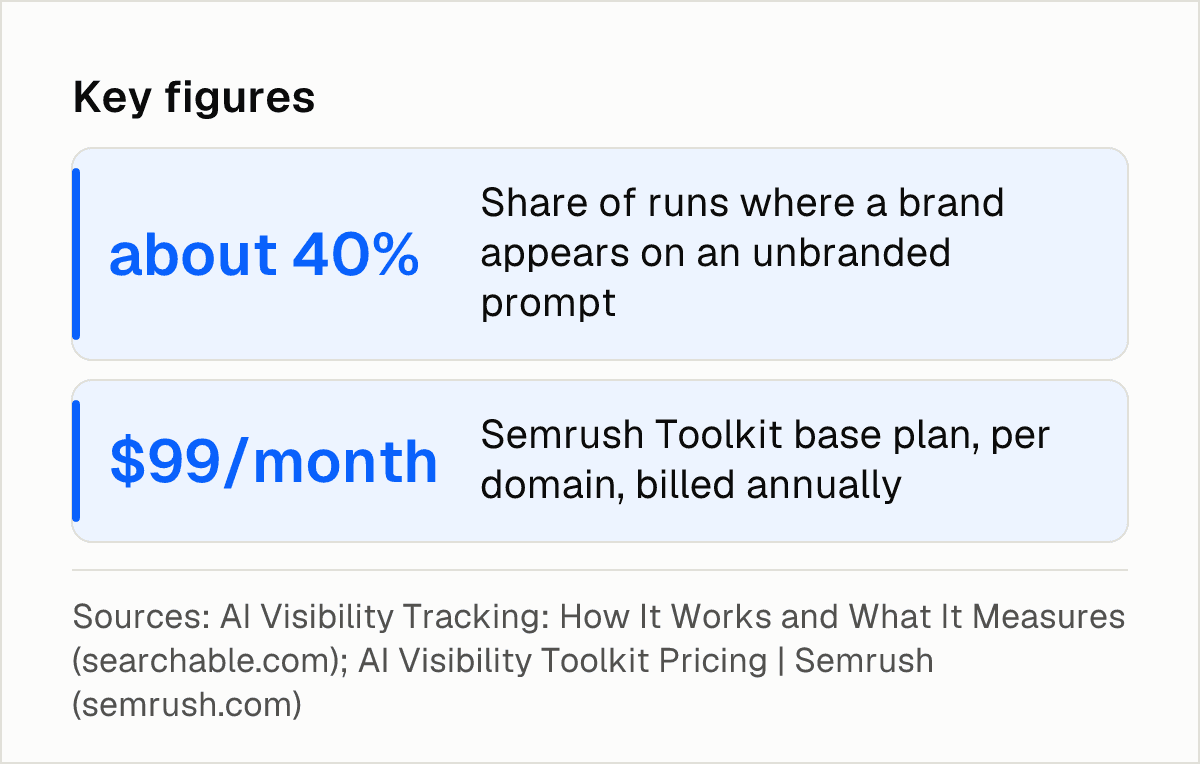
- Price per client, not per plan: Semrush's AI Visibility Toolkit starts at $99/month per domain, billed annually, while Citable Starter is $24/month per site. Both scale with the number of client sites.
- Workspaces before commitment: Otterly's Lite plan includes one workspace, so a multi-client roster usually means a higher plan.
- Does the tool act? Citable describes publishing changes to the client's CMS. Profound's AI Marketer stages page changes in the CMS, and Peec AI is described mainly as a tracker.
- Method details in writing: ask how many runs each prompt gets and whether you can see the raw answers. One check gives poor odds of seeing a brand.
What should a small agency need from an AI visibility tool?
Write your criteria before you open a pricing page. For most small agencies they are:
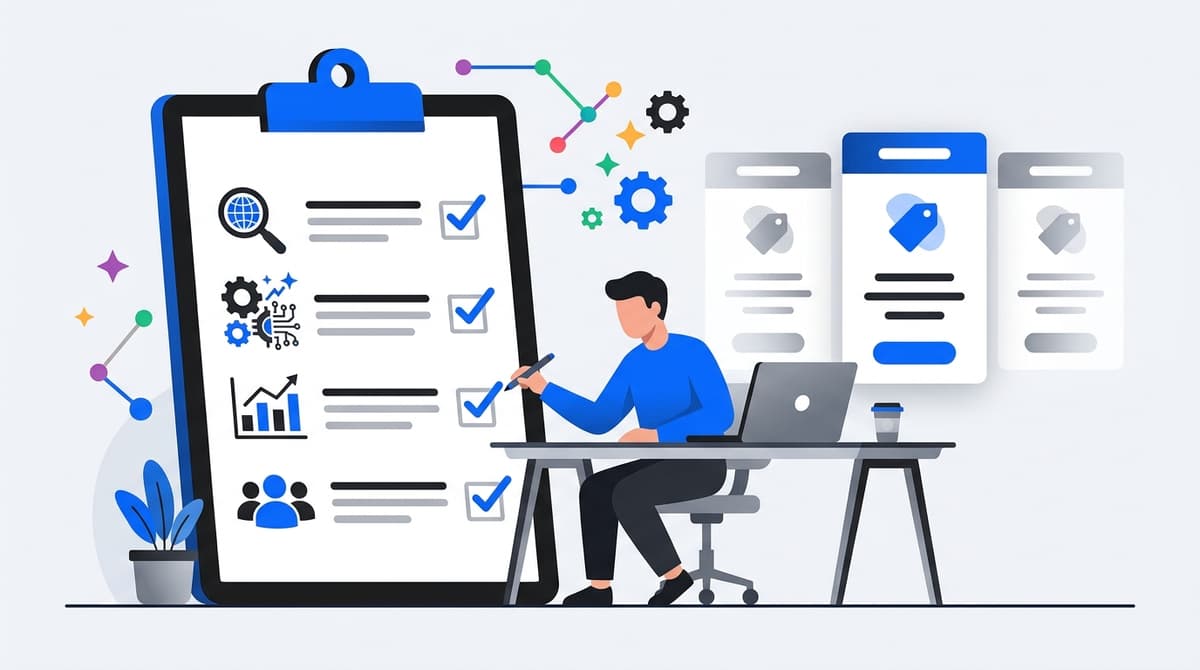
- Cost per client: the price at your current roster, not the headline entry price.
- Reporting: whether you can send white-label reports to clients.
- Workspaces: whether one subscription holds several clients cleanly.
- Engines: which AI tools are covered and which cost extra.
- Action: whether the tool changes anything on a client's site or only reports on it.
Pricing units matter as much as prices. The tools here charge by domain, by site, by prompt count or by credits. Those units behave differently as you add clients, so a tool can look cheap for two clients and expensive for ten. Semrush's reviewer notes in its agency roundup that an agency pays for each domain separately, and that the Toolkit tracks 25 prompts by default, with extra prompts as an add-on.
The options below are AthenaHQ, Citable, Otterly.ai, Peec AI, Profound and Semrush's AI Visibility Toolkit, listed alphabetically. The same five criteria apply to each.
How much does each option cost per client?
Entry prices are not comparable at face value, so each option is covered in turn before the summary table.
Semrush. The Toolkit starts at $99/month per domain, billed annually, with 25 custom prompts, according to Semrush's pricing page. An agency pays that amount for every domain, so the bill grows with the roster.
Otterly. Otterly lists its Lite plan at $29/month with 15 search prompts. Standard is listed at $189/month with 100 prompts, and Premium at $489/month with 400 prompts, according to Otterly's pricing page. The same page also shows a second set of prices, such as Standard at $160/month, next to a monthly and annual toggle. The page does not label which set applies to which billing period, so confirm the monthly price before you budget.
Peec AI. Peec sizes its plans by prompt count: Starter at 50 prompts, Pro at 150 and Advanced at 350, plus a custom Enterprise tier. Peec's pricing page offers unlimited users on every plan. The dollar amounts for the tiers did not appear on that page. One roundup lists plans from €89/month for 25 prompts and 3 engines. Semrush's reviewer cites a credit-based Essential plan from $245/month for 10,000 credits. Credits and prompts make like-for-like comparison hard, so ask Peec for the price that fits your roster.
Profound. Semrush's reviewer estimates that an agency should expect to pay at least $498/month, because the $99 Agency Growth plan requires a $399/month add-on for each full client workspace. That is the reviewer's estimate, not a published price.
Citable. Citable's pricing is $24/month per site on Starter, $48 on Growth and $90 on Business, with articles included from Starter. Like Semrush's per-domain model, this is a per-site charge, so the total rises with each client site you add. The Claude add-on costs +$9/month on Starter or +$15 on Growth. The Grok add-on costs +$9 on Starter, +$19 on Growth and +$35 on Business.
AthenaHQ. The sources consulted do not detail its pricing.
| Option | Pricing unit | Entry price as published | Extra costs mentioned |
|---|---|---|---|
| AthenaHQ | The sources consulted do not detail it | The sources consulted do not detail it | The sources consulted do not detail it |
| Citable | Per site | $24/month (Starter), $48 (Growth), $90 (Business) | Claude and Grok add-ons |
| Otterly.ai | Prompts, per plan | $29/month for Lite, 15 prompts | Claude, Google AI Mode and Gemini add-ons |
| Peec AI | Prompt count, unlimited users | Dollar price not shown on its pricing page | Third-party figures vary |
| Profound | Per client workspace | Agency pricing not on its homepage | Reviewer estimate of at least $498/month for an agency |
| Semrush AI Visibility Toolkit | Per domain, billed annually | $99/month, 25 custom prompts | Extra prompts, white-label reports |
A worked example shows the effect of per-site and per-domain pricing, which both grow in a straight line with the roster. With five clients, one site each, base plans and no add-ons, Citable Starter ($24 per site) comes to $120/month and Semrush's Toolkit ($99 per domain) to $495/month. With ten clients, the same assumptions give $240 against $990. Both bills double when the roster doubles; only the starting rate differs. This compares entry prices only, since the plans include different things.
Which options handle white-label reports and several clients?
Workspaces decide whether one subscription can hold several clients cleanly. Otterly's Lite plan includes one workspace, while its Standard plan lists unlimited workspaces. For an agency with more than one client, Lite is not enough on its own.
White-label reporting varies more:
- Semrush: white-label PDF reports cost extra, through a $20/month My Reports Pro add-on. Its reviewer also notes that you must run the Visibility Overview report each time you want a client's full mention and citation picture, with no single view across clients.
- Otterly: according to the same reviewer, it lacks native white-label reporting. The workaround is connecting it to Google Looker Studio.
- Citable: it offers reports and an API for agencies, and its guide on how agencies report AI search visibility to clients covers the reporting side in more detail. The sources consulted do not detail how workspaces or white-label options work per client, so ask before you rely on them.
- Peec AI: it offers unlimited users on every plan, which helps when several people on your team share access. The sources consulted do not detail its white-label options.
- Profound: the sources consulted do not detail its white-label options.
Outside this comparison, Rank Prompt says its Agency plan at $149/month includes white-label reports emailed to clients on a schedule. That is the vendor's own claim.
Which AI engines does each tool cover?
Engine coverage is a cost question as much as a feature question. On Otterly, Claude, Google AI Mode and Gemini are sold as extra add-ons on top of the base plan. If your clients need all three, add those costs to the base price.
According to Semrush's reviewer, Peec AI's lower-tier plans track up to six AI search platforms, while higher tiers reach eleven. Check which engines fall inside each tier.
Citable measures whether ChatGPT, Gemini, Perplexity, Claude, Grok and Google AI cite or recommend a site. That includes Google AI Mode, which differs from AI Overviews. Claude and Grok carry add-on prices on its Starter and Growth plans, and Grok also on Business, so budget for them if your clients need those engines.
For Semrush's Toolkit base plan, Profound and AthenaHQ, the sources consulted do not give a full engine list. Ask each vendor for one in writing.
Plan coverage can also shrink at higher prices. Semrush's reviewer notes that Scrunch's $500/month Agency Core plan includes only four of its nine supported platforms, which may deter smaller agencies. Scrunch is not in this comparison, but it shows why you should read the plan, not the platform list.
Does the tool fix pages or only report on them?
A tracker shows where your clients stand. It does not change their pages. Ask what happens after the dashboard shows a gap, because that answer separates these options more than price does.
- Peec AI: Semrush's reviewer describes it as primarily a tracking tool. Its recommendations feature was in beta at the time of the review.
- Profound: its homepage describes an AI Marketer that rewrites pages with citation decay and stages the changes in your CMS. Its agency pricing is not published there, and its enterprise positioning is aimed at large teams.
- Citable: it measures what AI tools say, works out why they recommend competitors instead, writes sourced articles and makes page fixes, then publishes them to the site's CMS. After that it checks whether the change worked. Citable also says it uses no link schemes.
- Otterly, Semrush and AthenaHQ: the sources consulted do not show whether they publish content or page fixes to a client's CMS.
Several tools offer recommendations. Judge how deep the feature goes, and whether it ends in a published change or a to-do list.
How reliable are AI visibility numbers?
A single prompt run tells you very little. A SparkToro and Gumshoe.ai study found that repeated prompts to major AI systems produce widely different brand lists. The researchers warned marketers against trusting tools that claim exact brand rankings, as Communicate Online reported.
Searchable reports that in its September 2026 data, a brand that appears on an unbranded prompt at all shows up in about 40% of that prompt's runs. One check gives poor odds of seeing your client, so track a mention rate across many runs rather than a single position.
Otterly's own 2026 study of its tracking data reached a related conclusion. Brand mentions were more stable over time than the citations behind them, and the study recommends brand coverage as the headline metric, with citations as a diagnostic layer.
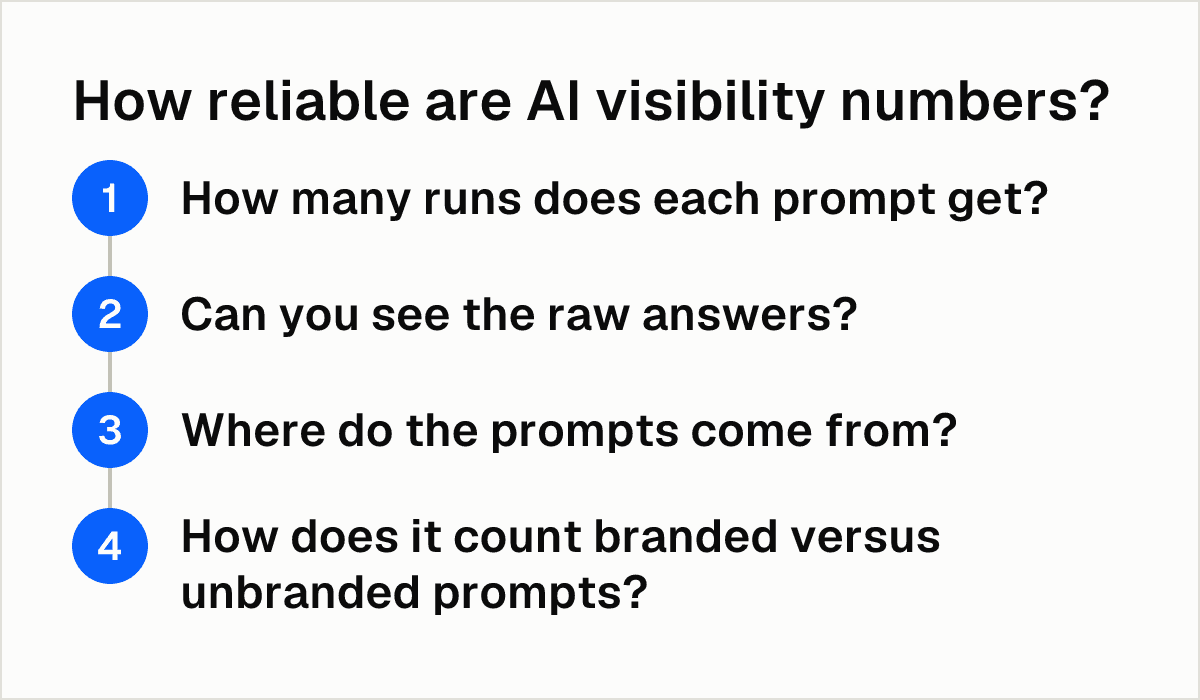
Searchable advises buyers to verify vendor claims against six factors, including runs per prompt, engine coverage and method, prompt origin, mention parsing and access to raw answers. Turn that into a short test for each vendor:
- How many runs does each prompt get?
- Can you see the raw answers?
- Where do the prompts come from?
- How does it count branded versus unbranded prompts?
To run your own first check, this guide to checking if ChatGPT recommends your brand explains why one prompt is not enough.
When should you choose each option?
AthenaHQ: the sources consulted do not detail its pricing, engines or reporting, so this comparison cannot place it on the criteria above. Request its pricing and engine list before you consider it.
Citable: choose it if you want the full loop of measuring, finding out why competitors are picked, publishing sourced articles and page fixes to each client's CMS, and checking the result. It suits agencies that want output that changes pages, not only a report. Its per-site pricing grows with each client, and you should check the Claude and Grok add-ons if your clients need those engines, and ask about workspaces and white-label options first.
Otterly.ai: choose it if you want a low entry price with prompt-based plans and can live without native white-label reporting. Lite has one workspace, so more clients means a higher plan. Confirm the monthly price, since the page shows two sets of figures.
Peec AI: choose it if you want unlimited users on every plan and prompt-count tiers, and mainly need tracking. Confirm the dollar price directly. Its recommendations feature was in beta at the time of Semrush's review.
Profound: choose it if you have a larger team or budget and want an agent that stages page rewrites in the CMS. For a small agency, Semrush's reviewer estimates at least $498/month, and the homepage publishes no agency pricing.
Semrush AI Visibility Toolkit: choose it if you already use Semrush and want AI visibility in the same platform. Per-domain costs grow with your roster, and white-label reports and extra prompts are priced separately.
Next steps
- List your clients and multiply each tool's per-domain, per-site, per-prompt or per-workspace price by your real roster, including add-ons for the engines your clients need.
- Send each vendor the four-question method test above and keep the written answers.
- Pick one client, run the same five buyer prompts several times by hand, and record how often the brand appears. You get a baseline to compare against any tool's numbers.
- Decide whether you want a tracker or a tool that publishes fixes, and drop the options that do not match.
- If you want a starting point for one client site, Citable's free AI visibility report shows whether ChatGPT mentions it.
Frequently asked questions
How much does AI visibility tracking cost per client for a small agency?
It depends on the pricing unit. Semrush charges per domain from $99/month, Otterly starts at $29/month for one workspace, and Citable charges $24/month per site on Starter. Per-domain and per-site prices both rise with each client, so add engine add-ons and white-label reports before you compare totals.
Which AI engines should a small agency track?
Track the engines your clients' buyers use. ChatGPT, Gemini, Perplexity, Claude, Grok and Google AI Mode are the main candidates. Some tools charge extra for some of them, as Otterly does for Claude, Google AI Mode and Gemini.
Can I white-label AI visibility reports for my clients?
Some tools can, at varying cost. Semrush sells white-label PDF reports through a $20/month add-on, and Otterly has no native white-label reporting. Rank Prompt says its Agency plan includes scheduled white-label reports, and Citable offers reports and an API for agencies.
Do AI visibility tools show exact rankings, or only mention rates?
Mention rates are the safer metric. The SparkToro and Gumshoe.ai researchers warned against tools claiming exact brand rankings, because repeated prompts produce widely different brand lists. Otterly's study also found brand mentions more stable than citations.
Do AI visibility tools fix the content, or only report on it?
Most mainly report. Peec AI is described as primarily a tracker. Profound describes staging page rewrites in your CMS, and Citable writes sourced articles and page fixes and publishes them to the CMS.
Sources
- AI Visibility Toolkit Pricing | Semrush
- OtterlyAI Pricing
- 7 best AI visibility tracking tools for agencies by need
- Pricing for Peec AI
- Best AI Visibility Tracking Tools (2026)
- Best AI Visibility Tools for Agencies: White-Label (2026)
- Profound | The AI Platform to Power Your Marketing
- AI brand recommendations vary, marketers warned on tracking tools
- AI Visibility Tracking: How It Works and What It Measures
- 252,407 AI Answers Later: Brand Coverage Holds, Citations Churn
Keep reading
25 November 2026 · 9 min read
Why AI Doesn't Recommend Your Framer Studio, and What to Check
If AI skips your Framer studio, test whether crawlers can read your pages, then measure buyer questions and strengthen thin project evidence and unclear pages.
24 November 2026 · 11 min read
Hand-written or AI-drafted: six checks for AI citations
Hand-writing or a weekly AI service? Neither wins by default: six checks on review, sourcing, disclosure and measurement decide which fits you.
23 November 2026 · 7 min read
What Google AI Overviews are and how to measure them
Google AI Overviews are AI-generated summaries on some searches. You can't turn them off, but you can measure impressions, clicks and citations.