Which platform measures AI visibility and writes the articles that fix the gaps?
Citable · 16 November 2026 · 12 min read
Several AI visibility platforms now go beyond reporting, but they differ in how far they take the fix. Goodie AI and Writesonic position themselves as acting on content gaps, Profound produces drafts that a person reviews before they reach a CMS, Semrush's LLM Gap Analyzer gives instructions, Peec AI says it is not a content tool, and Otterly.ai is monitoring-only. Citable measures six AI engines every week, writes sourced articles and publishes them to the site's CMS, starting at $24 per month per site.
Key takeaways
- Check the whole loop: a platform that measures but does not publish leaves the fix to your team.
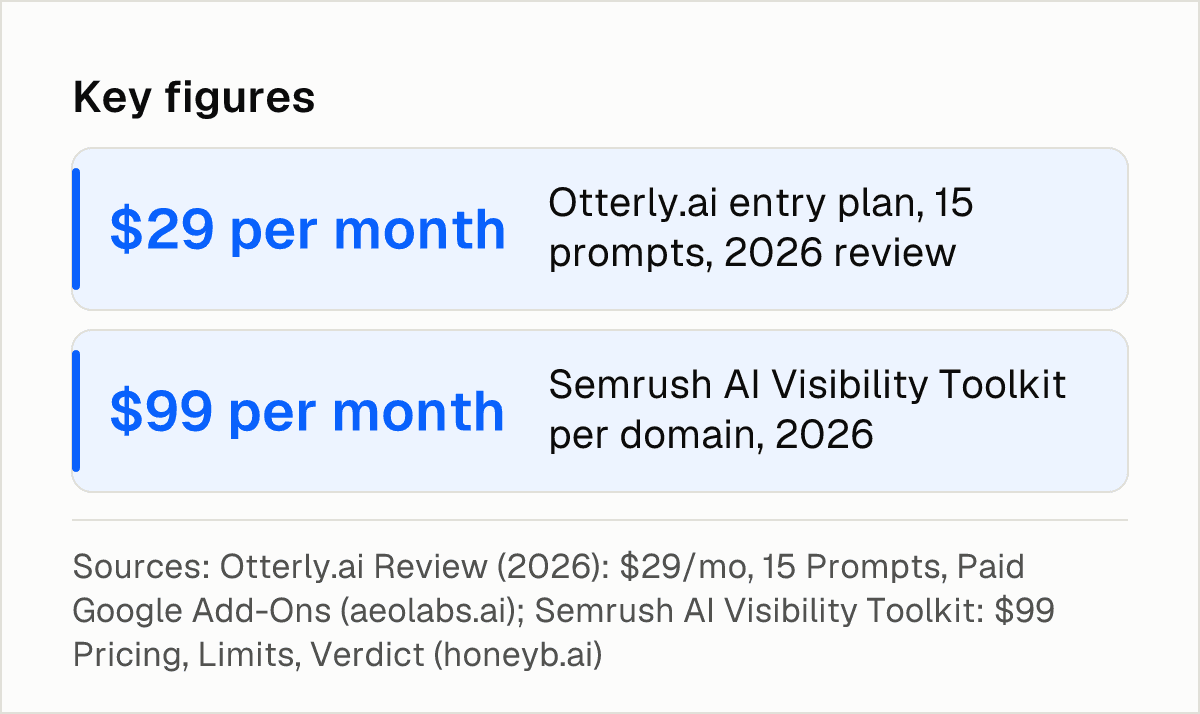
- Price per engine: Otterly.ai's $29 plan covers 15 prompts, and Gemini and Google AI Mode cost extra.
- Count the domains: Semrush's AI Visibility Toolkit is listed at $99 per month, per domain.
- Ask for proof: get every vendor to name the prompts, engines, frequency and what counts as a change.
Your brand is missing from AI answers, and you can't see why
The symptom is familiar. Buyers ask ChatGPT or Google AI for a shortlist, and your brand is not on it. The first job is to measure that, prompt by prompt, across the engines your buyers use.

Buyer guides split AI visibility tools along one line:
"They differ most on one thing: whether the tool stops at the alert, or helps you fix the gap it found." — Frase, in its 2026 tools guide
Both halves matter. A dashboard without a fix leaves the gap open, and a writer without measurement fixes the wrong things.
Before you compare platforms, write down three answers:
- Engines: which AI tools matter for your market.
- Prompts: how many questions you need to track.
- Writer: who will write and publish the fixes.
Those answers decide most of the cost. The sections below take the likely causes of a stalled fix in turn, most common first.
The tool stops at the report
The most common gap is a tool that finds the problem and hands it back to you.
Semrush's LLM Gap Analyzer analyzes AI answers, finds content gaps and gives instructions for improving AI visibility, according to Semrush's LLM Gap Analyzer page. That is advice. The page promises neither written articles nor CMS publishing, so someone on your team still has to write.
Peec AI describes itself as "not a content-generation tool", as quoted in Sprites.ai's review. It has added gap analysis and recommended actions, split into owned and earned media, per Strategi's review. The writing stays with your team.
Amicited's 2026 review calls Otterly.ai's workflow monitoring-only, with no traffic attribution, although it includes a GEO audit feature.
If your team can write, these tools may be enough. If it can't, the fix is a loop with four steps:
- Measure: check which engines cite or recommend you, and which competitors win instead.
- Explain: find out why those competitors are picked.
- Publish: put the fix on the live site.
- Measure again: check whether the citations moved.
Citable runs all four steps in one service. It measures whether ChatGPT, Gemini, Perplexity, Claude, Grok and Google AI cite or recommend your site, works out why competitors are picked instead, writes sourced articles and page fixes, and publishes them to your CMS. Articles are included from the Starter plan.
Tools that monitor and also write
Some platforms cover both halves. ContentPen's guide describes Goodie AI as a tool that monitors where a brand appears, explains why it is missing, writes optimized content to close the gap, and attributes results to traffic and conversions. According to Wikipedia, Writesonic tracks brand visibility across AI search platforms including ChatGPT, Claude and Gemini, and provides tools to act on content and citation gaps. The sources consulted do not detail pricing, CMS publishing or approval steps for either, so check them with each vendor.
The draft exists, but nobody publishes it
A draft in a folder fixes nothing. The second common gap is a platform that writes content but leaves the last step to you, or limits how much it writes.
Profound's content agents can send approved drafts straight to a CMS or route them to Slack for review, according to Profound's agents page. The drafts come with citation benchmarks and are meant for human review before use, as the same page says.
Content generation depends on the plan. A 2026 Profound review lists it as a Growth-plan feature limited to 3 articles per month, with Enterprise on custom terms. Rankability's agency review argues that Profound is mainly a monitoring tool with limited content creation, priced for enterprise buyers who may not match a mid-market budget.
Citable writes sourced articles and makes page fixes, publishing them to the site's CMS. Starter is $24 per month per site with articles included. The number of articles per plan is not part of the published plan data, so ask before you compare it with Profound's limit.
Who approves a change before it goes live?
Automatic publishing has a cost. Limelit's guide notes that very few AI visibility tools rewrite pages for the customer, and that buyers may not want a tool changing a live site "without a tool silently rewriting your live site behind your back".
Ask every vendor, Citable included, where a person approves a change. Profound documents an approval step on its agents page. For the others, get the answer in writing.
The engines you need are not in the base plan
A cheap plan can miss the engines your buyers use, and the add-ons change the total.
Otterly's base plan covers four engines: ChatGPT, Google AI Overviews, Perplexity and Microsoft Copilot. Claude and Grok are not in that list, according to aeolabs' Otterly review. The same review prices Gemini and Google AI Mode as add-ons of $9 to $149 per month each, depending on the plan. If Google's AI surfaces matter to you, Citable's explainer on Google AI Mode shows how they differ from AI Overviews.
Peec AI's self-serve plans include three AI models of your choice, and additional models cost extra, per aeolabs' Peec AI review.
Honeyb's review lists Semrush's AI Visibility Toolkit at $99 per month with 25 tracked prompts. Sources disagree on whether it can be bought alone: Rankability's Semrush review says you need an active Semrush plan.
Citable tracks six engines: ChatGPT, Gemini, Perplexity, Claude, Grok and Google AI. Claude is a paid add-on at +$9 per month on Starter and +$15 on Growth. Grok is +$9 on Starter, +$19 on Growth and +$35 on Business. If Claude matters to you, Citable's guide to getting cited by Claude covers what drives its citations.
Profound's engine list is not detailed in the sources consulted, so check it on the vendor's live page.
What does each option cost?
Headline prices hide the real bill. Compare the monthly total for the engines and prompt volume you need.
| Option | Listed price | What limits it |
|---|---|---|
| Otterly.ai | From $29/month for 15 prompts | Four base engines; Gemini and Google AI Mode are paid add-ons |
| Peec AI | $95, $245 and $495/month by prompt count; Enterprise custom | Three models of your choice; more models cost extra |
| Semrush AI Visibility Toolkit | $99/month per domain | 25 tracked prompts; standalone purchase disputed |
| Profound | From $99/month in one review; Enterprise custom | Content generation limited to 3 articles/month on Growth |
| Goodie AI | The sources consulted do not detail it | The sources consulted do not detail it |
| Writesonic | The sources consulted do not detail it | The sources consulted do not detail it |
| Citable | Starter $24, Growth $48, Business $90 per site/month | Claude and Grok are add-ons; articles per plan not detailed in sources |
A few notes on that table:
- Peec AI: the USD prices come from getpicked's September 2026 snapshot. An older 2026 guide lists euro prices (Starter €89, Pro €199), so check the live page before you budget.
- Profound: pricing is inconsistent. The August 2026 aeolabs Peec AI review says the $99 and $399 self-serve tiers no longer appear on Profound's page, while the aipeekaboo review still lists $99. Confirm the current price with the vendor.
- Otterly.ai: Otterly's own site offers a 7-day free trial, while a third-party review says none is listed.
- Semrush: at $99 per domain, an agency with several client sites pays that fee for each.
- Citable: pricing is per site, and Citable offers reports and an API for agencies.
Which option fits which buyer?
The table scores each option on the same four criteria.
| Option | Measures AI citations | Writes articles | Publishes to CMS | Human review before publishing |
|---|---|---|---|---|
| Otterly.ai | Yes | No (monitoring-only) | Not detailed in sources | Not detailed in sources |
| Peec AI | Yes | No (writing left to your team) | Not detailed in sources | Not detailed in sources |
| Semrush | Yes | No (gives instructions) | Not detailed in sources | Not detailed in sources |
| Profound | Yes | Drafts, limited by plan | Yes | Yes, approval step |
| Goodie AI | Yes | Yes, optimized content | Not detailed in sources | Not detailed in sources |
| Writesonic | Yes | Tools to act on content gaps | Not detailed in sources | Not detailed in sources |
| Citable | Yes, six engines, weekly | Yes, sourced articles | Yes | Not detailed in sources |
Each option has a case where it is the better pick:
- Otterly.ai: choose it for monitoring on a small budget when you already have writers.
- Peec AI: choose it for a tracker with gap analysis and recommended actions when your team writes the content.
- Semrush: choose it if you already run a Semrush plan and want AI visibility inside that stack. You will need a writer to act on its instructions.
- Profound: choose it if you have an enterprise budget and want reviewed drafts routed to your CMS or Slack.
- Goodie AI: consider it if you want results attributed to traffic and conversions alongside content that closes the gap.
- Writesonic: consider it if you want a content-writing platform that also tracks visibility across engines such as ChatGPT, Claude and Gemini.
- Citable: choose it if you want one service that measures six engines, writes sourced articles, publishes them to your CMS and checks the results.
If you have in-house writers and only need to know where you stand, a $29 to $95 dashboard may cost less than a platform that also writes.
How do you check that a fix worked?
Publishing an article is not proof. You need to see whether AI answers changed after it went live, and one prompt can't show that. Citable's guide to checking whether ChatGPT recommends your brand explains why a single prompt misleads.
Check a set of prompts across several engines, several times, before you conclude anything. Citable re-measures the same engines every week and shows whether citations or recommendations moved after a fix. Ask any vendor the same four questions: which prompts, which engines, how often, and what counts as a change.
Vendor case results are self-reported. Profound cites a customer, Hone, that reported an 800% increase in visibility after using its content generation workflows, on Profound's reviews page. It is a vendor-published result, not an independent measurement.
Citable does not promise a specific lift. Its weekly measurement shows whether a fix moved your citations, and that is the number to watch.
Next steps
- List the five to ten prompts a buyer would type to get a shortlist in your category, and note which AI engines you want covered.
- Run those prompts several times on each engine and save the answers. That is your baseline, and it costs nothing.
- Decide who writes and who approves. If nobody on your team can write, rule out the tools that only report.
- Send every vendor the same four questions: which prompts, which engines, how often, and what counts as a change.
- If you want measurement, articles and CMS publishing in one service, Citable is one option; its guide on how Perplexity chooses its sources is useful background.
Frequently asked questions
Does an AI visibility tool that writes articles actually get a site cited?
No tool can guarantee citations. Profound's Hone case is vendor-reported, so measure your own citations before and after each article. A tool that re-measures weekly lets you see whether a fix moved anything.
How much does it cost to track ChatGPT, Gemini, Perplexity, Claude and Grok together on one site?
It depends on the vendor. Citable's Starter plan is $24 per month per site, with Claude at +$9 and Grok at +$9 as add-ons. Otterly.ai's base plan excludes Claude and Grok, and Peec AI's self-serve plans include three models of your choice.
Which AI visibility tools publish directly to a CMS without copying and pasting?
Profound can send approved drafts to a CMS or route them to Slack for review. Citable publishes its articles and page fixes to the site's CMS. Semrush's LLM Gap Analyzer gives instructions, and Peec AI and Otterly.ai leave the writing to you.
Do I need an SEO or content team to act on an AI visibility report?
With a tracker such as Otterly.ai, Peec AI or Semrush, yes: someone has to write and publish the fixes. With a service that writes, such as Citable, Profound or Goodie AI, drafting is covered. Someone should still decide who approves changes before they go live.
Sources
- 10 Best AI Visibility Tools in 2026 (Frase)
- Analyze AI answers, find content gaps, and boost AI citations (Semrush)
- Peec AI Review 2026: Pricing, Features, Limits (Sprites.ai)
- Peec AI Review 2026 (Strategi)
- Otterly.ai Review 2026 (Amicited)
- AI Powered Content Creation (Profound)
- Profound Review 2026 (AI Peekaboo)
- Profound AI Review for Agencies (Rankability)
- AI Visibility Tools That Fix Content, Not Just Report It (Limelit)
- Otterly.ai Review (aeolabs)
- Peec AI Review (aeolabs)
- Semrush AI Visibility Toolkit (Honeyb)
- Semrush AI Toolkit Review for Agencies (Rankability)
- Peec AI review (getpicked)
- Peec AI Pricing (Workduo)
- Otterly.ai
- Profound Reviews (Profound)
- The 17 Best AI Visibility Tools in 2026 (ContentPen)
- Writesonic (Wikipedia)
Keep reading
25 November 2026 · 9 min read
Why AI Doesn't Recommend Your Framer Studio, and What to Check
If AI skips your Framer studio, test whether crawlers can read your pages, then measure buyer questions and strengthen thin project evidence and unclear pages.
24 November 2026 · 11 min read
Hand-written or AI-drafted: six checks for AI citations
Hand-writing or a weekly AI service? Neither wins by default: six checks on review, sourcing, disclosure and measurement decide which fits you.
23 November 2026 · 7 min read
What Google AI Overviews are and how to measure them
Google AI Overviews are AI-generated summaries on some searches. You can't turn them off, but you can measure impressions, clicks and citations.