Why ChatGPT Names Your Competitors and Not Your Site: Causes Compared
Citable · 27 November 2026 · 11 min read
Key takeaways
- Check robots.txt first. A block on OAI-SearchBot has a direct, documented effect, according to OpenAI.
- Allow time after a change. A robots.txt fix does not show up the same day.
- The studies disagree. Research on how often ChatGPT cites business websites gives opposite readings, depending on category and method.
- Run each question several times. One answer tells you little, because answers change between runs.
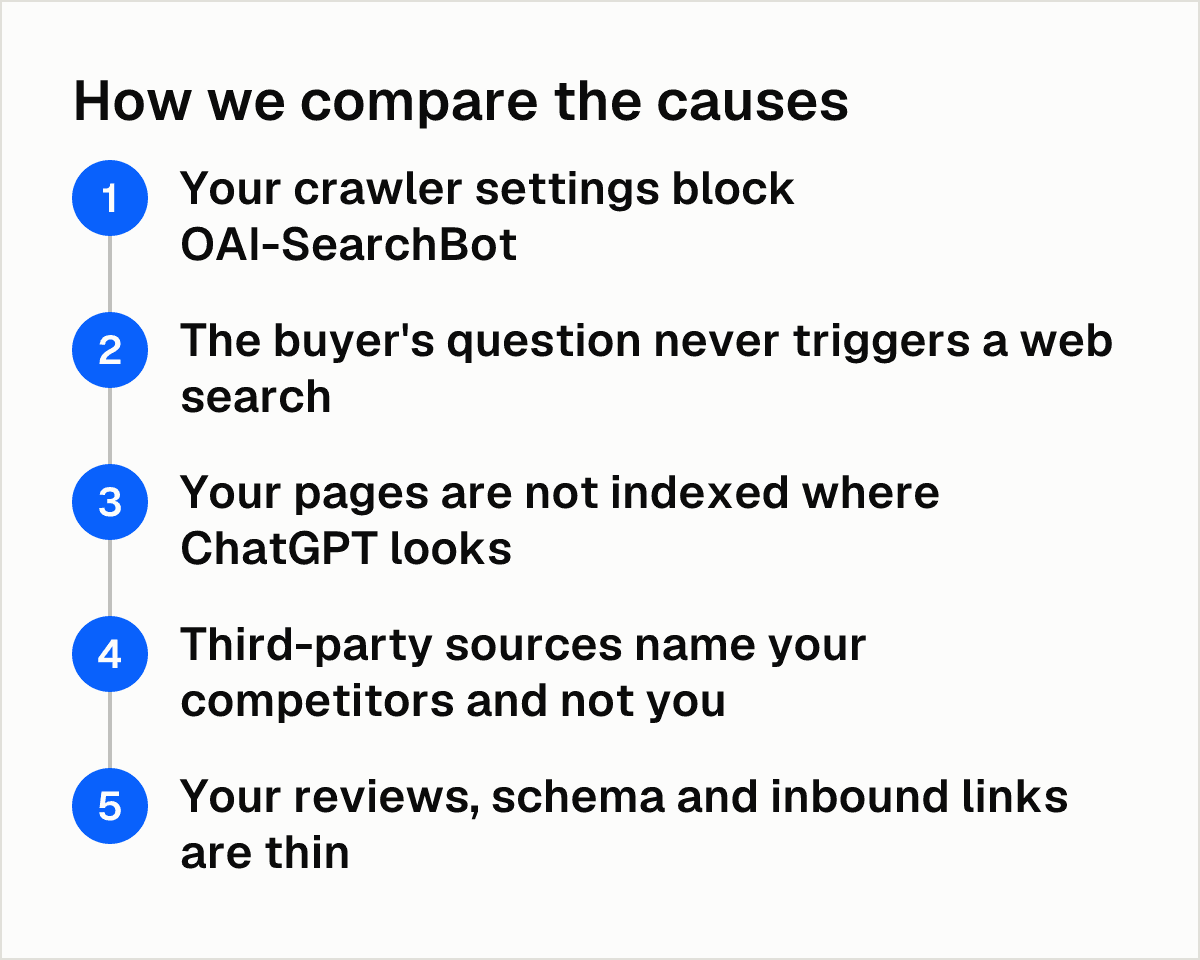
How we compare the causes
There is no single reason ChatGPT skips a site. There are five candidate causes, and we apply the same four criteria to each: what it does to your visibility, how strong the evidence is, how to check it, and when to check it.
The five causes:
- Your crawler settings block OAI-SearchBot.
- The buyer's question never triggers a web search.
- Your pages are not indexed where ChatGPT looks.
- Third-party sources name your competitors and not you.
- Your reviews, schema and inbound links are thin.
The summary table and the order to check them in come at the end.
Does ChatGPT search the web for your question at all?
ChatGPT does not search for every prompt. According to OpenAI's help article on ChatGPT search, it searches automatically if a question might benefit from information on the web. When a question does not trigger a search, the answer has no live sources, so a missing citation on that run says little about your site.

When it does search, access is the first filter. OpenAI's publisher FAQ states that any public website can appear in ChatGPT search, provided OAI-SearchBot is not blocked.
The reason to care is growing. BrightLocal's 2026 survey, cited by Sunday Able, found that 45% of consumers had used ChatGPT or another AI tool to find a local business, up from 6% the year before.
Is OAI-SearchBot blocked in your robots.txt?
OpenAI's crawler documentation says sites opted out of OAI-SearchBot will not be shown in ChatGPT search answers, though they can still appear as navigational links. A block is therefore a direct cause of invisibility.
GPTBot and OAI-SearchBot are independent settings. A site can allow search and disallow training. A guide from Alrebro makes the same point: blocking GPTBot does not remove you from ChatGPT search.
Semrush says AI crawlers are allowed by default, so you only have a problem if you have actively blocked them. The check is quick and decisive when it fails. It explains nothing if your file is already open.
The test takes minutes:
- Open yoursite.com/robots.txt in a browser.
- Search the file for OAI-SearchBot.
- Read any Disallow rule in the group that names it.
- Wait after any change before you judge the result.
OpenAI's documentation says it can take about 24 hours from a robots.txt update for its systems to adjust. For the full list of AI user agents, see Citable's guide to robots.txt and AI crawlers.
Which search index does ChatGPT read?
OpenAI's help article says ChatGPT may share disassociated search queries with third-party search providers such as Bing. Bing is the only provider it names in that document.
Third-party explainers go further. Geoswift says ChatGPT retrieves results from Bing's index before it evaluates them. That is an outside explanation, not an OpenAI statement.
The evidence conflicts. A Pluspoint study of 210 ChatGPT answers to dining questions, from August 2026, found that none read a Google, Bing, Apple or Yelp business page to choose its picks.
One consequence holds either way. Semrush says AI search platforms rely on live search-engine results, so your site has to be indexed before it can show up in their answers. It lists Bing as the engine used by ChatGPT and Brave as the one used by Claude. If you track Claude as well, note that Semrush says Brave offers no sitemap submission channel.
Make sure your pages are indexed in the search engines you can reach. Then test the answers instead of trusting one theory about the index.
Which sources name your competitors instead of you?
This is where the evidence points most often, and where the studies disagree most.
Pluspoint reports that only about 4% of the sources an AI answer links to are the business's own website. Its sample covers dining queries only.
A Cheers study of home-services answers reads the other way. Across 9,434 ChatGPT answers collected between August 31 and September 20, 2026, business websites were cited in 88.3%. The samples and categories differ, so the mix of sources you compete with depends on what your buyers ask.
The same Cheers study found ChatGPT citing Expertise.com in 32.1% of answers and Angi or HomeAdvisor in 29.4%, but Yelp in only 0.6%. In some categories, directories and lead sites outrank a business's own domain.
The Yelp number depends on what you measure. Steady Demand's August 2026 test of 2,880 prompts found Yelp in the structured business-card data of 95.83% of ChatGPT local responses. The same write-up reports that Axios said on July 23, 2026 that Yelp is licensing reviews, photos and business information to OpenAI. Citations and business-card data are different measures, which is why 0.6% and 95.83% can both be true.
Across engines, the picture shifts again. Yext's study of 6.8 million AI citations, published in October 2025, found that 86% come from sources brands control, such as websites and listings. That covers ChatGPT, Gemini and Perplexity together. Another Cheers report says 48.73% of ChatGPT citations came from third-party sites such as Yelp, TripAdvisor and MapQuest, so ChatGPT leans on outside sources more than the aggregate suggests.
Selection is also narrow. In SOCi's 2026 study of more than 350,000 business locations, ChatGPT recommended just 1.2% of them.
Semrush argues that third-party presence matters more than Google rank: a business can rank well on Google and still suffer poor AI visibility if its off-site presence is thin. Semrush also admits that AI platforms have not publicly documented how they select local businesses, so treat its explanation as an inference.
How much do reviews, schema and links count?
The evidence is thinnest here, and every claim below comes from vendors.
- Reviews: Semrush says AI platforms look at how many Google reviews you have, plus their star ratings and content. It publishes no methodology.
- Schema: Semrush recommends LocalBusiness, Service, FAQPage and AggregateRating markup. It notes that Google no longer shows FAQ rich results but says the markup still helps AI parse your Q&A. That benefit is asserted, not measured.
- Links: a DV8 study of about 129,000 websites reports that referring domains were the strongest single predictor of ChatGPT citation. Its methodology is unpublished, but it points to off-site references mattering.
Earn those references legitimately: get listed in the directories you qualify for, get cited in sources that already cover your category, and answer questions where your buyers ask them. Link schemes are not a shortcut.
How do you find the sources behind a competitor's mention?
One prompt is not enough. ChatGPT answers the same question differently across runs, as Citable explains in why ChatGPT gives different answers to the same question.
The method has four steps:
- Write the questions your buyers actually ask.
- Run each one several times.
- List every business named and every source linked.
- Compare the sources behind competitor mentions with the places where you appear.
Then change what you can: fix access, correct listings, earn mentions in the sources that already name your competitors. Measure again on a fixed schedule so you see a trend, not a single result. No one can promise a ChatGPT recommendation, because it depends on factors you do not control. For more on the competitor side, read why AI cites your competitors instead of you.
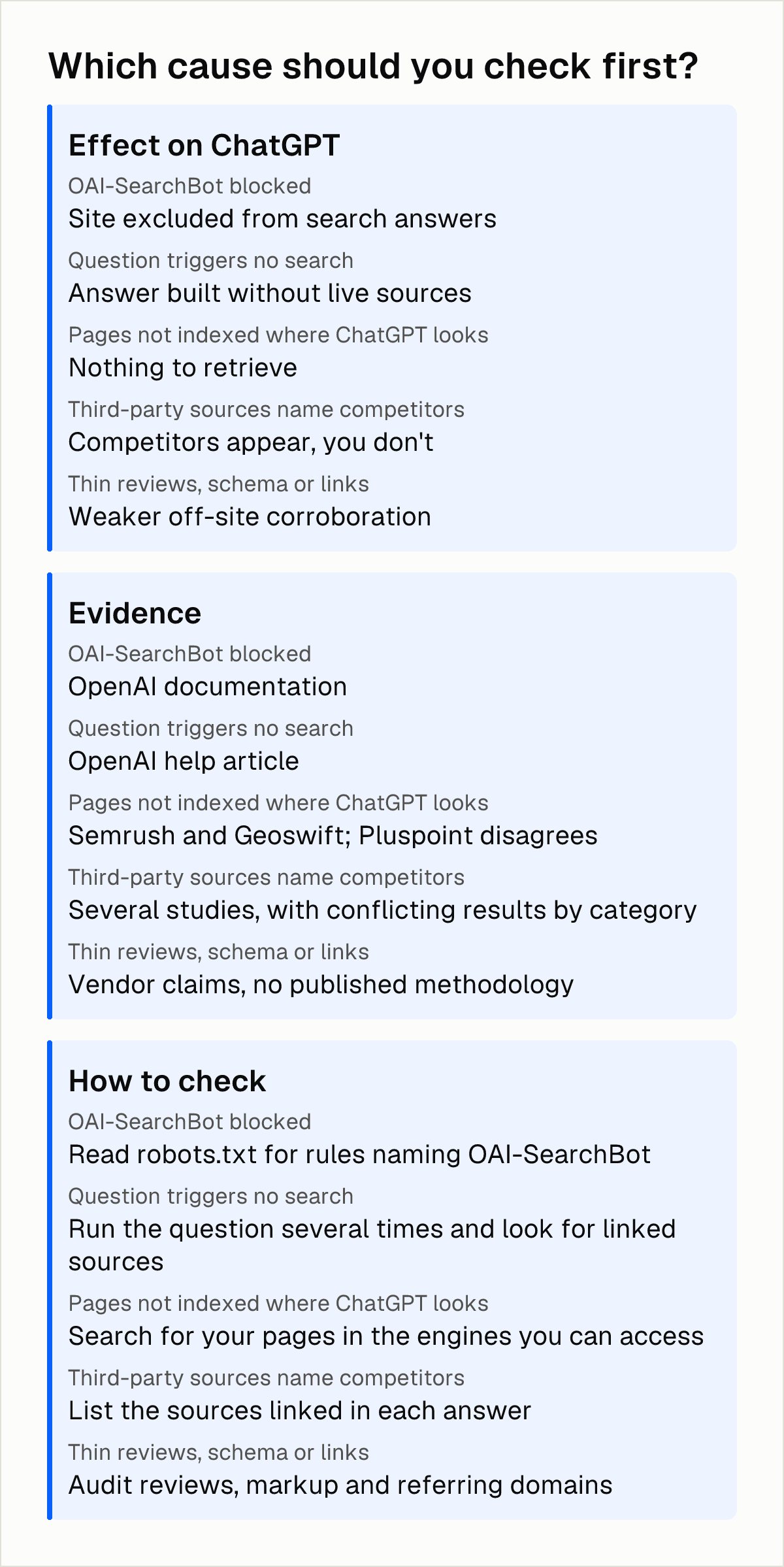
Which cause should you check first?
| Cause | Effect on ChatGPT | Evidence | How to check |
|---|---|---|---|
| OAI-SearchBot blocked | Site excluded from search answers | OpenAI documentation | Read robots.txt for rules naming OAI-SearchBot |
| Question triggers no search | Answer built without live sources | OpenAI help article | Run the question several times and look for linked sources |
| Pages not indexed where ChatGPT looks | Nothing to retrieve | Semrush and Geoswift; Pluspoint disagrees | Search for your pages in the engines you can access |
| Third-party sources name competitors | Competitors appear, you don't | Several studies, with conflicting results by category | List the sources linked in each answer |
| Thin reviews, schema or links | Weaker off-site corroboration | Vendor claims, no published methodology | Audit reviews, markup and referring domains |
When to start with each:
- Blocked crawler: always first. It costs minutes and is the cause OpenAI documents as having a direct effect.
- No search trigger: when you show up for some phrasings of a question and not others.
- Indexing: when robots.txt is open and your pages are hard to find in search engines.
- Third-party sources: when the same competitors appear across runs and your robots.txt is clean.
- Reviews, schema and links: after the others, as slower work that supports the rest.
Next steps
- Open your robots.txt today and look for any rule naming OAI-SearchBot. If you change it, wait about a day before testing.
- Write the ten questions a buyer would ask to find your type of service, and run each one several times in ChatGPT.
- Record every business named and every source linked, then mark which sources mention a competitor and not you.
- Claim or correct your listings in the directories that appear most often in those answers.
- If you want this measured weekly, Citable tracks whether ChatGPT, Gemini, Perplexity, Claude, Grok and Google AI cite or recommend your site, and works out why competitors are picked instead. Plans start at $24/month per site; its guide on how to check if ChatGPT recommends your brand shows the manual method first.
Frequently asked questions
How can I check whether ChatGPT is blocking my site with robots.txt?
Open yoursite.com/robots.txt and look for OAI-SearchBot. A Disallow rule in its group excludes you from ChatGPT search answers. A rule for GPTBot alone blocks training, not search.
Does ChatGPT use Bing or Google to find websites to cite?
OpenAI names Bing as a third-party search provider, and Semrush and Geoswift say ChatGPT draws on Bing's index. Pluspoint's dining study found no answer that read a Google, Bing, Apple or Yelp business page to choose its picks. Make sure your pages are indexed, then test the answers.
How long does it take for ChatGPT to start citing a website after changes?
OpenAI says a robots.txt update can take about 24 hours to reach its search systems. For new pages or mentions, there is no stated schedule, so measure weekly over several runs instead of waiting for a date.
Which directories does ChatGPT cite for local service businesses?
It depends on the category. In the Cheers home-services study, Expertise.com and Angi or HomeAdvisor were cited far more often than Yelp. In Steady Demand's test, Yelp data was present in nearly all local responses as business-card data. Run your own buyer questions and list the sources linked.
Sources
- ChatGPT search (OpenAI Help Center)
- Publishers and Developers FAQ (OpenAI Help Center)
- How to get ChatGPT to recommend your business (Sunday Able)
- Why Doesn't ChatGPT Recommend My Business? 9 Fixes (Alrebro)
- How to do AI search optimization for local businesses (Semrush)
- How ChatGPT Chooses Its Sources (Geoswift)
- How to Get ChatGPT to Recommend Your Business in 2026 (Pluspoint)
- Where Does ChatGPT Get Its Information? Local Data 2026 (Cheers)
- ChatGPT Local Business Recommendation Rate (Driven Metrics)
- Yext Research: 86% of AI Citations Come from Brand-Managed Sources
- How Consumers Use AI to Find Local Businesses in 2026 (Cheers)
- How ChatGPT Picks Local Businesses (Shift in Life)
- Why ChatGPT Doesn't Recommend Your Business (DV8)
Keep reading
26 November 2026 · 11 min read
AI blog posts and Google: what the evidence says
Google doesn't penalize AI blog posts as such, but it does penalize spam. See what studies say on rankings, citations, labelling and cost.
26 November 2026 · 5 min read
What an AI Agent Does to Get ChatGPT to Recommend You (in 25 Seconds)
A 25-second video of everything an AI visibility agent does at once: hundreds of questions to six AIs, keywords classified and articles published. What each part is, why it matters and how to run a manual version in 15 minutes.
25 November 2026 · 9 min read
Why AI Doesn't Recommend Your Framer Studio, and What to Check
If AI skips your Framer studio, test whether crawlers can read your pages, then measure buyer questions and strengthen thin project evidence and unclear pages.