Does Schema Markup Help in AI Search? What the Google and Ahrefs Data Show
Citable · 4 November 2026 · 7 min read
On current evidence, schema markup is not a lever for getting cited by AI search. Google says generative AI search requires no special schema.org markup, and a controlled test by Ahrefs found no major citation uplift on any platform. Keep structured data for rich-result eligibility in Google Search, and check citations yourself instead of assuming schema did the work.
- Google says generative AI search needs no special schema.org markup. Structured data still has a place for rich results.
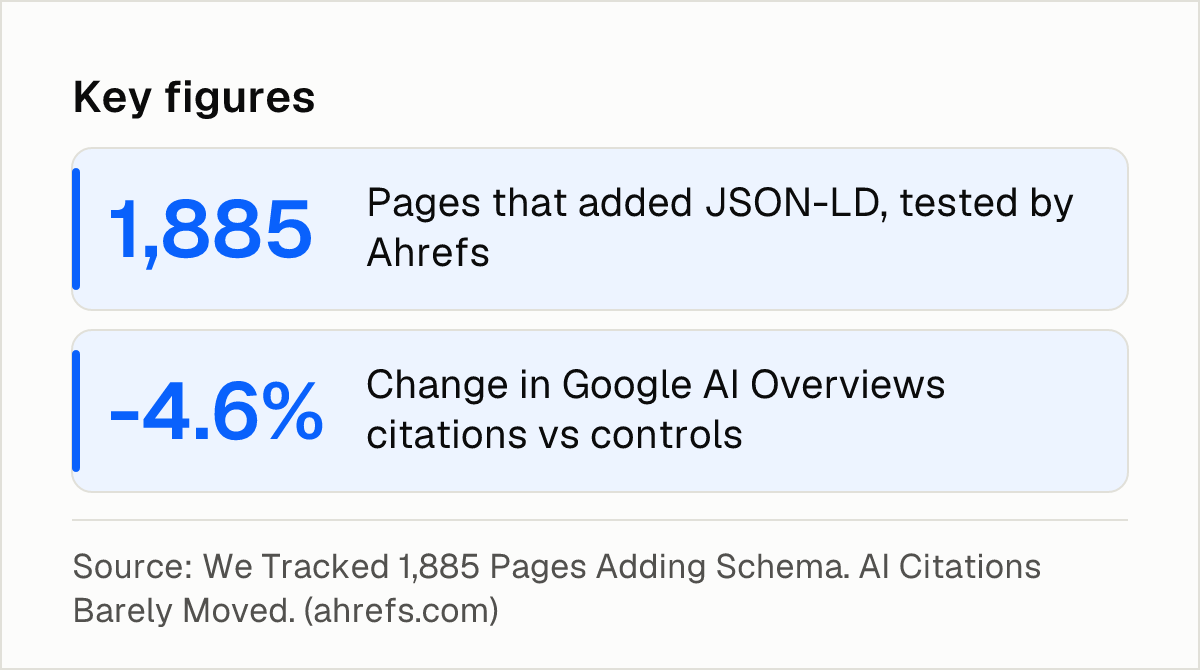
- Ahrefs tracked 1,885 pages that added JSON-LD and found no major citation uplift on any platform.
- The one statistically significant change was a small drop in Google AI Overviews citations.
- Record which pages AI tools cite before a change, then check again over several weeks.
What does Google say about schema and AI search?
Google's guide on generative AI features is direct about it:

"Structured data isn't required for generative AI search, and there's no special schema.org markup you need to add." — Google's AI optimization guide, updated 10 July 2026
The same guide still tells site owners to keep using structured data as part of SEO, because it helps pages qualify for rich results in Google Search. It also lists "overfocusing on structured data" among the tactics site owners can ignore for generative AI search.
So Google puts schema in the rich-results column, not the AI-answers column. For the wider picture on what Google does say, read how to appear in Google AI Overviews.
What did Ahrefs' controlled test find?
Ahrefs tracked 1,885 pages that added JSON-LD between August 2025 and March 2026 and compared them with 4,000 control pages. Its conclusion: adding schema produced no major uplift in citations on any platform.
| Platform | Change vs matched controls | Statistically significant? |
|---|---|---|
| Google AI Overviews | −4.6% | Yes, but small |
| Google AI Mode | +2.4% | No, indistinguishable from zero |
| ChatGPT | +2.2% | No, indistinguishable from zero |
Ahrefs describes the AI Overviews decline as small: about 12 daily citations per page. Treat it as a reason not to expect a boost, not as a reason to remove schema.
The study has a stated limit. Every page in its sample already had 100+ AI Overview citations before schema was added, so the data says nothing about pages that AI systems do not yet see.
Does the 3x gap prove that schema works?
Ahrefs also found that AI-cited pages were almost three times more likely than non-cited pages to carry JSON-LD. That gap is a correlation. Ahrefs explains it by where schema tends to live: on better-maintained, more authoritative sites. Its causal test was built to check exactly this, and it found no major uplift in citations from adding schema.
Other studies point the same way. A December 2024 Search/Atlas study, covered by Search Engine Land, found no correlation between schema coverage and citation rates. Sites with comprehensive schema did not consistently outperform sites with minimal or no schema.
A preprint by Kurt Fischman analysed 730 AI citations from ChatGPT and Gemini. It found an initial negative association, which the author attributes to a methodological artifact. Within Google, schema prevalence among cited and non-cited pages was statistically indistinguishable: 43.1% vs 44.8%.
Is there any evidence that schema helps?
Some, and it is narrow. Schema may still help AI systems crawl, parse or index pages they have not yet found, a case Ahrefs says its sample does not cover.
According to Belmore Digital, Microsoft's Fabrice Canel said at SMX Munich in March 2025 that schema markup helps Bing's LLMs understand content for Copilot. That is a platform statement about understanding, not a measured citation lift.
On real-time retrieval, Ahrefs reports an experiment by searchVIU in which none of five AI systems used schema when fetching a page. All of them extracted only visible HTML content.
Belmore Digital's review counts one null-result empirical study, zero peer-reviewed research and many vendor-funded claims. It adds that many widely quoted schema statistics have no credible source. A percentage lift with no named study behind it is a claim, not a result.
How should you use schema without overclaiming?
Google's structured data guidelines require markup to describe only content that is visible on the page. NYTRO SEO's summary notes that violations can cost rich results or trigger a manual action. Markup that does not match the page is a risk with no documented upside.
How that applies by type of site:
- Ecommerce: mark up only the products and details the page shows, and keep them in sync when prices or stock change.
- Local businesses: use the name, address and contact details that readers can see on the page.
- Content and FAQ pages: mark up only questions and answers that appear on the page.
- Agencies: report schema as rich-result work. Don't promise clients AI citations from it.
The benefit Google documents is rich-result eligibility in Google Search. For a fuller look at what does and doesn't help, see structured data for AI search.
How do you check whether schema changed your citations?
Ahrefs could isolate schema because it compared thousands of treated pages with matched controls. A single site rarely has enough comparable pages to do that, so a before-and-after change on your own site is a signal, not proof.
For Google, Google's guide points to the Generative AI performance report in Search Console. It also warns that no third-party tool has access to Google's internal ranking or AI systems.
A routine that works without any tool:
- Before: list the questions your buyers ask and record which pages AI tools cite for them.
- Change: make the schema or page change and note the date.
- After: check the same questions on the same platforms over the following weeks.
Change one thing at a time. If you edit copy, schema and internal links together, you cannot say which one moved the result.
Next steps
- Audit your existing markup against what each page shows, and remove anything the visible content doesn't support.
- Keep or add schema where it makes a page eligible for Google rich results, such as product or business details.
- Write down which pages AI tools cite for your ten most important buyer questions today, with the date.
- Open the Generative AI performance report in Search Console and note your starting point.
- If you want that tracking done weekly across ChatGPT, Gemini, Perplexity, Claude, Grok and Google AI, Citable does it as described in how Citable measures and checks results.
Frequently asked questions
Does Google require schema markup for AI Overviews?
No. Google's guide says structured data isn't required for generative AI search and that no special schema.org markup is needed.
Should I keep structured data if it does not lift AI citations?
Yes, if it describes visible content and makes the page eligible for rich results. Google still recommends structured data as part of SEO for that reason. Just don't count on it to earn AI citations.
Can schema hurt my visibility if it does not match the page content?
It can. Google's guidelines require markup to describe only visible content, and NYTRO SEO notes that violations can cost rich results or trigger a manual action. Fix mismatches before adding more markup.
How do I measure whether schema changed my AI citations?
Record the pages AI tools cite for your key questions before the change, then check the same questions again over several weeks. For Google, use the Generative AI performance report in Search Console. A single-site comparison is a signal, since Ahrefs needed thousands of matched pages to isolate the effect.
Sources
- Google's Guide to Optimizing for Generative AI Features on Google Search
- We Tracked 1,885 Pages Adding Schema. AI Citations Barely Moved. (Ahrefs)
- How schema markup fits into AI search — without the hype (Search Engine Land)
- Does Schema Markup Predict AI Citation? (Kurt Fischman, SSRN)
- Does Schema Markup Help LLMs? What the Evidence Actually Shows (Belmore Digital)
- How Structured Data Works (NYTRO SEO)
Keep reading
6 November 2026 · 9 min read
Step by step: how to monitor competitors in AI search
Build a fixed set of buyer prompts, run them on the AI engines your buyers use, and track share of voice and cited sources over time to monitor competitors.
5 November 2026 · 7 min read
FAQ pages that AI assistants quote: what the evidence shows
Write each FAQ heading as the question a buyer types and answer it in one or two standalone sentences. Schema alone showed no citation lift in tests.
3 November 2026 · 6 min read
AI search content strategy: what Google says, what to test
Google says its AI features rest on core Search systems, so start with SEO basics. See which AI tactics to drop and what to test on ChatGPT and Perplexity.