AI search content strategy: what Google says, what to test
Citable · 3 November 2026 · 6 min read
An AI search content strategy starts with SEO basics, because Google says its generative AI features are rooted in its core Search ranking and quality systems. Results on ChatGPT, Perplexity and other platforms need their own measurement, because Google's guidance does not cover them.
- Check indexing, snippet eligibility and Search Console inclusion before you judge any AI result.
- Stop treating llms.txt and content chunking as Google requirements.
- Keep two lists: what Google confirms for its own AI features, and what you test on other platforms.
- Track your own prompts and cited sources. The Search Console report covers Google only.
What SEO base do Google's AI features use?
Google's guide states it plainly:

"our generative AI features on Google Search are rooted in our core Search ranking and quality systems" — Google, in its AI optimization guide
A page must be indexed and eligible to show in Google Search with a snippet, and the site must be included in Search generative AI features in Search Console. The first checks are ordinary SEO work:
- Indexing: confirm your key pages are in Google's index.
- Crawl access: make sure Google can reach them without blocks.
- Page structure: use clear headings and a logical hierarchy.
- Accuracy: correct facts, prices and dates before anything else.
Then confirm in Search Console that the site is included in generative AI features. Without that, you cannot read the results correctly.
Which AI-specific tactics can you drop?
Several tactics sold for AI visibility have no role in Google's guidance.
llms.txt and AI-specific files
Google says site owners can ignore llms.txt and similar files, because Google Search ignores them: they neither help nor harm visibility there. Other services may still use them, so the decision depends on which platforms you care about. Our llms.txt explainer covers what the file does and whether it helps.
Chunking content for AI
Google says there is no requirement to break content into tiny pieces for AI to understand it, and there is no ideal page length. Write for the reader first, with headings that make the page easy to scan.
Rewriting pages only for AI
Any change should make the page clearer for people. If an edit only helps a machine, skip it.
Does Google's advice apply to ChatGPT and Perplexity?
No. Google's guidance covers Google only. As Search Engine Journal notes, it does not settle the debate for non-Google platforms like ChatGPT or Perplexity, which may weight signals differently.
The same outlet describes the May 2026 guide as telling site owners to skip tactics that a growing industry of AEO/GEO services has been promoting. That is a reason to test vendor claims before you adopt them. Google also says no third-party tool has access to its internal ranking or AI systems, and it tells site owners to judge third-party advice against its official guidance.
So keep two lists. The first holds what Google confirms for its own AI features. The second holds what you test elsewhere, with your own prompts and your own records.
Should you write first-hand content instead of recycled content?
Yes. Google advises writing from first-hand experience and not recycling what others have said or what a generative AI model could easily produce. That matters for any workflow that uses AI to draft articles.
Google also says that creating content primarily to manipulate rankings or AI responses violates its scaled content abuse spam policy. It does not replace the facts, examples and checks that only your team has.
A useful test: could a reader learn something from this page that a generic AI answer cannot give? If not, the page is not ready to publish.
Do extra pages and mentions help AI visibility?
Advice conflicts here. Profound's playbook recommends that, instead of targeting the surface-level prompt, you target the searches the model runs, known as query fan-out. Google says that creating separate pages for every fan-out query, primarily to manipulate AI responses, violates its spam policy.
A rule that fits both: add a page only when it covers a distinct question, adds first-hand detail, and would still be useful if no AI tool existed.
Mentions and outreach
Google's guide says seeking inauthentic "mentions" across the web isn't as helpful as it might seem. Do not build a plan on mention volume alone.
How do you measure and recheck AI search results?
Search Console now has a Generative AI performance report for AI Overviews and AI Mode. According to Google's post on new controls, the rollout reached all websites worldwide as of August 31, 2026.
The same post says sites can opt out of Google's generative AI features, and opted-out sites receive no traffic or impressions from them. Decide this on purpose. The post also says AI Overviews has over 2.5 billion monthly active users and AI Mode has surpassed one billion monthly users. That is scale, not a forecast for your site. For background on how the two differ, see our Google AI Mode explainer.
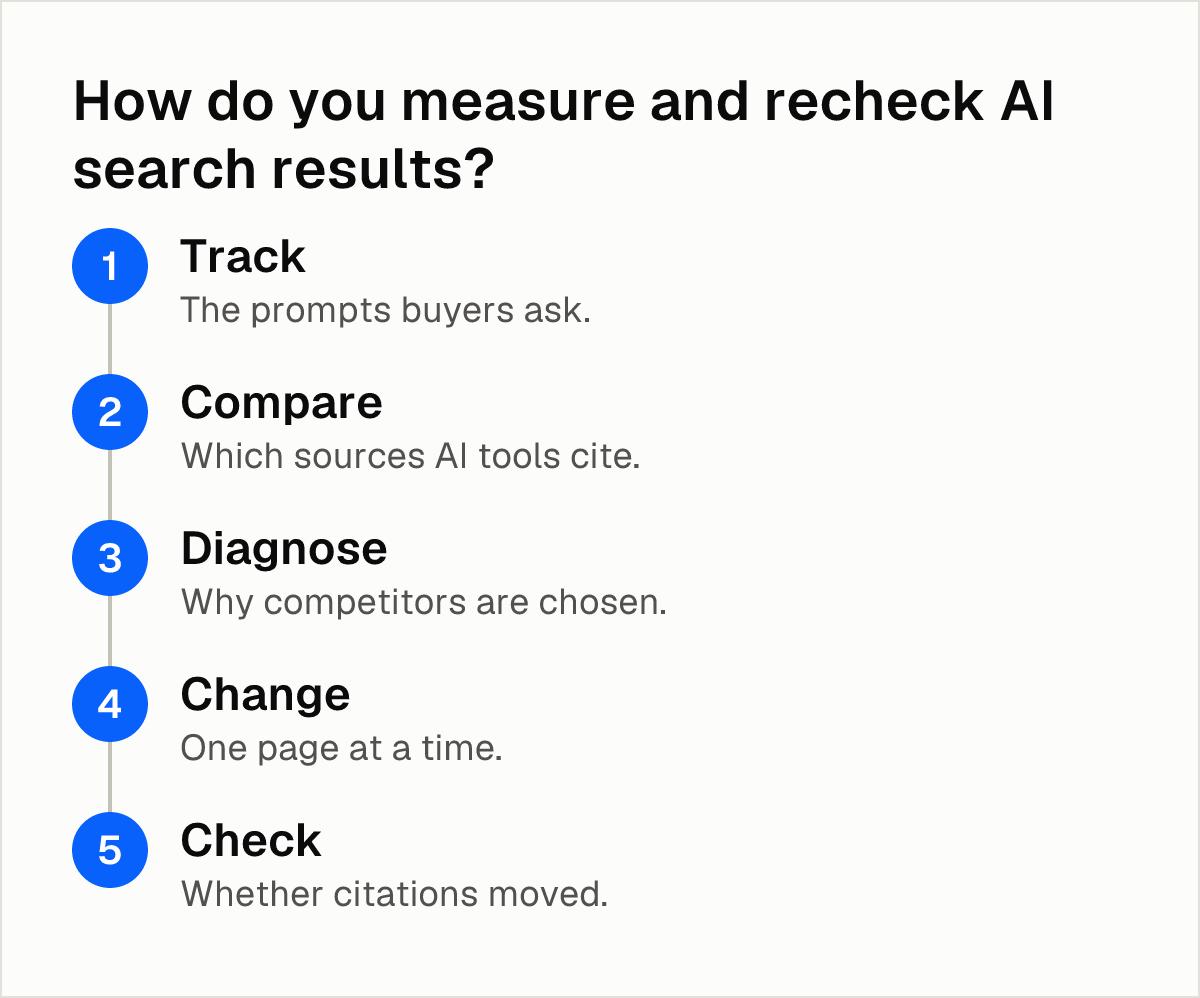
The report covers Google only. For other platforms, track prompts, answers and cited sources yourself. A simple loop works:
- Track: the prompts buyers ask.
- Compare: which sources AI tools cite.
- Diagnose: why competitors are chosen.
- Change: one page at a time.
- Check: whether citations moved.
Next steps
- Confirm indexing and Search Console inclusion for your key pages.
- Decide your crawler policy for AI bots. Our robots.txt and AI crawlers guide covers GPTBot, OAI-SearchBot, PerplexityBot, ClaudeBot and Google-Extended.
- Pick 10 to 20 prompts your buyers actually use and record which sources AI tools name for each.
- Change one page at a time, then recheck the same prompts after a set period so you can tell what moved.
- If you want this loop run weekly, Citable measures whether ChatGPT, Gemini, Perplexity, Claude, Grok and Google AI cite or recommend a site, then writes sourced articles and page fixes. Its free AI SEO tools include a visibility report.
Frequently asked questions
Does llms.txt help my site get cited by ChatGPT or Perplexity?
Google says Google Search ignores llms.txt, so it neither helps nor harms visibility there. Other services may use such files. Test it against your own prompts on those platforms.
Is AI-written content penalised by Google?
It advises against recycling what others have said or what a generative AI model could easily produce, and it says content made primarily to manipulate rankings violates its spam policy.
Are paid or outreach-driven mentions worth it for AI recommendations?
Google's guide says seeking inauthentic "mentions" across the web isn't as helpful as it might seem for its AI features. Its guidance does not settle other platforms, so measure those separately.
How do I opt out of Google's generative AI features?
Google announced a Search Console toggle for this. Sites that opt out will not receive traffic or impressions from those features.
Sources
Keep reading
6 November 2026 · 9 min read
Step by step: how to monitor competitors in AI search
Build a fixed set of buyer prompts, run them on the AI engines your buyers use, and track share of voice and cited sources over time to monitor competitors.
5 November 2026 · 7 min read
FAQ pages that AI assistants quote: what the evidence shows
Write each FAQ heading as the question a buyer types and answer it in one or two standalone sentences. Schema alone showed no citation lift in tests.
4 November 2026 · 7 min read
Does Schema Markup Help in AI Search? What the Google and Ahrefs Data Show
Schema markup is not a proven lever for AI citations: Google says it isn't required and an Ahrefs test found no major uplift. Here is what to do.