Is a monthly AI visibility plan worth it for your store?
Citable · 28 November 2026 · 10 min read
A small monthly fee does not buy a ChatGPT recommendation. ChatGPT's organic product results are not ads, so a monthly fee can only pay for measurement, diagnosis and content work. Check the basics first (feeds, Shopify, crawlable product pages, US sales), then judge any paid tool by repeated checks over several weeks.
What to keep in mind
- Organic product picks in ChatGPT cannot be bought. Paid feed ads are a separate channel, labelled as sponsored.
- Shopify, readable product pages and US sales cover most of the basics. Fix any gap before you pay a monthly fee.
- One ChatGPT answer is weak evidence. The same prompt rarely returns the same brand list twice.
- A small monthly plan buys measurement and content work. Set a threshold for continuing or stopping before you start.
Why can't a monthly fee buy a place in ChatGPT's product results?
Organic product results in ChatGPT are not ads. A vendor summary of OpenAI's help documentation says products are chosen on relevancy, price, metadata quality and product reputation.
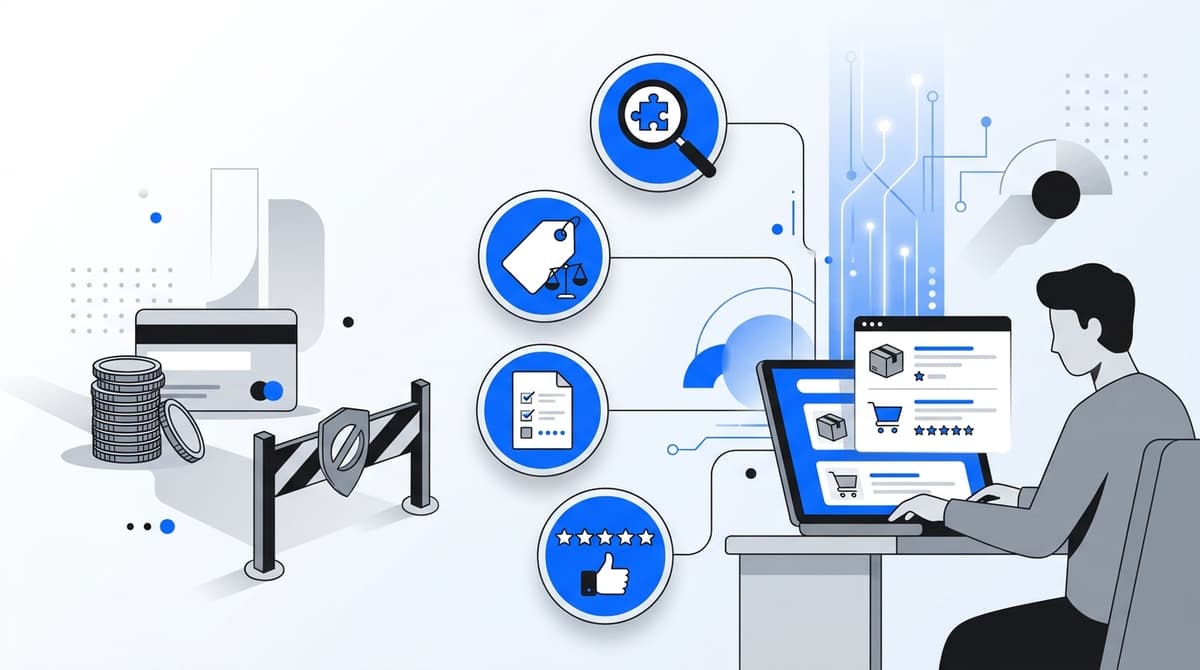
Paid placement is a separate channel. Product-feed ads appear below the response and are clearly labelled as sponsored. A vendor FAQ quotes OpenAI saying that ads never influence ChatGPT's answers, a position it has held since February 2026.
A B2B GEO guide goes further and says no AI platform offered paid placement in generative answers as of early 2026. That is a vendor's claim, not an official platform statement.
So a fee can pay for three jobs: checking what ChatGPT says, finding out why it picks other stores, and making your pages and content easier to recommend. A good tool should show you its work on each one.
Which channel is the money going to: organic, shopping research or ads?
Organic shopping results do not require a feed. OpenAI's merchant page says a product feed is optional, because ChatGPT also crawls websites. A store can be found without sending one.
Shopping research, the buyer's-guide mode, works differently. Merchants must pass an OpenAI allowlisting process before they can appear in its results.
OpenAI's own evaluation puts shopping research at 52% product accuracy on multi-constraint queries, against 37% for standard ChatGPT Search. That is an internal figure, not an independent test.
Feed ads have a floor. The ads feed can take up to one million SKUs per advertiser but needs at least 100 SKUs to start, so a small catalogue may not qualify. The same report says OpenAI describes feed-based ads as among the strongest-performing formats in its Ads Beta program. That is a company claim with no independent figures.
A tool that measures organic answers does not get you into shopping research, and a feed ad is not an organic recommendation. If a proposal mixes the two, ask which line of the budget goes to each.
What should you fix before paying for any tool?
Three checks cost nothing and are worth doing before you pay for any tool.
Are you on Shopify?
For Shopify merchants, OpenAI says product data is already integrated into ChatGPT through Shopify Catalog, and individual merchants need no additional work. If you are on Shopify, the feed step is largely handled. Your job is to keep the product data in your store accurate.
Are your product pages readable and complete?
Because ChatGPT also crawls websites, product pages that can be read and that hold clear details matter. Merchant feeds and public pages with incomplete or inconsistent data can produce incomplete or out-of-date results. Audit titles, prices, availability and descriptions on your own pages. Citable has written about how AI shopping tools read a product page and what to fix.
Do you sell to the United States?
ChatGPT shopping is live for users in the United States, and standard feed uploads target the US, according to the same Cresclab merchant guide. If most of your sales are elsewhere, organic shopping results may do little for you today.
If you are on Shopify, your pages are readable and complete, and you sell mainly in the US, the basics are largely in place. If any of the three is missing, fix it first. A monthly tool cannot correct it for you.
Why does one check of ChatGPT tell you so little?
AI answers change between runs, and a single screenshot proves very little. SparkToro's research makes the point:
"ChatGPT and Google Search AI Overviews each returned the same brand list less than 1% of the time across repeated runs of the same prompt." — SparkToro research, via Search Engine Journal
Frequency is more useful than rank. In the same SparkToro and Gumshoe.ai study, the ranking order of brands varied widely, but how often certain brands appeared was more consistent. A store that shows up in many runs tells you more than a store that once landed in position two.
Wording matters too. A preprint from Unusual found that small changes in phrasing produce substantially different brand recommendations. A fixed prompt set can therefore measure how a question is worded as much as how strong a brand is.
Citable's guides cover the same ground: how to check if ChatGPT recommends your brand explains why one prompt is not enough, and why ChatGPT gives different answers looks at the variation itself.
Whatever you use, ask for repeated runs over several weeks, reported as how often your store appears, with the prompts listed. A report with a single rank for a single prompt does not answer the question you are paying to have answered.
Are small stores at a disadvantage in AI answers?
Yes, according to one vendor study. In a 2026 Ranqo preprint, niche and small brands appeared in just 11% of relevant answers on their first run, against 73% for global household names. The authors sell in this market, so read the figure as one study's view of the gap.
Ranking well on Google does not secure a citation either. An Originality.ai analysis, cited in a GEO guide from The HOTH, found that 52% of AI citations come from outside the top 100 organic results.
Format matters. The same preprint reports that ranked best-of listicles are the most-cited content format, at about 21% of all citations. For a store, the useful reading is that comparison content built on explicit, sourced criteria has a place in the mix.
The same paper summarises the Princeton and Georgia Tech KDD 2024 GEO study, which found that quotations, statistics and citations each gave roughly 25–40% more visibility. That was measured in a controlled 10,000-query setting, not on product sales, so it is a reason to write carefully sourced pages and not a sales forecast. Citable's guide on using AI for content briefs while keeping the facts right is relevant if you draft that content with AI help.
If your store is small and sells a generic category, expect to be absent from brand-level answers for a while. Aim effort at the specific product questions where you can realistically be named: a particular material, size, use case or customer type.
Where do the sources disagree on what feeds ChatGPT's picks?
OpenAI's own documentation names structured metadata, merchant feeds and the open web as inputs. Some third-party analyses say ChatGPT assembles options largely from Google Shopping and Bing data, and they disagree on which input matters most.
A Semrush test of 100 shopping prompts, reported by Alhena, found that ChatGPT's top product recommendation matched Google Shopping's top three results 75% of the time. That suggests Google Shopping data may feed what ChatGPT shows, though it is a single test.
No mechanism is settled, so be wary of any advisor who promises one. The safe practice is to keep your product data accurate everywhere it is read: your site, your feed and your Google Shopping listing.
What does a monthly plan buy, and how do you test it?
Citable is a weekly AI-visibility service. It measures whether ChatGPT, Gemini, Perplexity, Claude, Grok and Google AI cite or recommend a site, finds out why competitors are picked instead, then writes sourced articles and makes page fixes, publishing them to the site's CMS. Citable also says it uses no link schemes. Its plans are priced per site, in tiers, with add-ons for some of the AI tools.
Whatever the tool and price tier, compare options using the same criteria for each: what it measures, how often it re-runs prompts, whether it explains why competitors win, and what it changes on your site. Running a fixed prompt set by hand is the baseline to compare against, so ask what a paid tier adds beyond that: scheduled runs, diagnosis, fixes, published content.
No tool can promise an outcome, and a monthly plan cannot buy a recommendation. Ask for evidence in the reports, not promises.
A test makes the decision easier:
- First week: confirm the Shopify setup or the feed, check that product pages can be read, and confirm where most of your sales are.
- Next several weeks: track a fixed set of buyer questions, run it repeatedly, and record how often your store appears instead of its rank.
- Before you start: decide how often your store must be named, and for which questions, to justify the next month's fee.
If the number does not move once the basics are fixed and the test has run its course, stop and put the money into the product pages themselves.
Next steps
- Check your setup: Shopify Catalog or a feed, readable product pages, and where most of your sales are. Fix gaps before paying for anything.
- Write 10 to 15 questions a buyer would ask about your products, using different wording for the same need.
- Run them by hand on a fixed schedule for several weeks and log how often your store is named, not its position.
- Write down your continue-or-stop threshold before the first run.
- If you want the weekly runs, diagnosis and page fixes done for you, Citable does this as described in its guide to measuring your brand's visibility in ChatGPT.
Frequently asked questions
Do I need a product feed for ChatGPT, or is my website enough?
A feed is optional. OpenAI's merchant page, as quoted by Cresclab, says ChatGPT also crawls websites, so a store can be found without one. Shopping research is different and requires passing an OpenAI allowlisting process.
Does Shopify automatically list my products in ChatGPT?
OpenAI says product data for Shopify merchants is already integrated into ChatGPT through Shopify Catalog, with no extra work required from individual merchants. Keeping your product data accurate is still your job.
Do paid ads in ChatGPT change which products it recommends?
OpenAI has stated since February 2026 that ads never influence ChatGPT's answers, according to the Tru Commerce FAQ that quotes it. Feed ads appear below the response and are labelled as sponsored.
Is ChatGPT shopping available outside the United States?
The Cresclab guide says shopping is live for users in the United States and that standard feed uploads target the US. Stores selling mainly elsewhere may get little from organic shopping results.
Is it worth paying a monthly fee for AI visibility tools if the results vary so much?
It can be, if the tool measures repeated runs and reports how often your store appears. SparkToro found the same brand list came back less than 1% of the time for ChatGPT, so single snapshots mislead. Pay only for a tool that reports frequency across many runs.
Sources
- Prefer: how to get recommended in ChatGPT shopping
- Digiday: OpenAI makes it easier to run shopping ads in ChatGPT
- Tru Commerce: ChatGPT Product Feed, Merchant Guide
- Mersel: Generative Engine Optimization (GEO) for B2B
- Cresclab: How to Get Your Products into ChatGPT Shopping
- Search Engine Journal: ChatGPT Adds Shopping Research
- ALM Corp: OpenAI Now Lets Retailers Run Product Feed Ads Inside ChatGPT
- OpenAI: Powering Product Discovery in ChatGPT
- The Rundown: ChatGPT Shopping Research
- Search Engine Journal: AI Recommendations Change With Nearly Every Query
- Communicate Online: AI brand recommendations vary
- Paraphrase Brittleness in Production Retrieval-Augmented Commercial Recommendation (arXiv)
- Generative Engine Optimization at Scale (arXiv)
- The HOTH: Generative Engine Optimization (GEO)
- Netalith: How to Get Your Products Recommended in ChatGPT
- Alhena: How ChatGPT Shopping Decides Which Products to Recommend
Keep reading
27 November 2026 · 11 min read
Why ChatGPT Names Your Competitors and Not Your Site: Causes Compared
ChatGPT can only cite what it can retrieve. Check OAI-SearchBot in robots.txt first, then see which sources name your competitors.
26 November 2026 · 11 min read
AI blog posts and Google: what the evidence says
Google doesn't penalize AI blog posts as such, but it does penalize spam. See what studies say on rankings, citations, labelling and cost.
26 November 2026 · 5 min read
What an AI Agent Does to Get ChatGPT to Recommend You (in 25 Seconds)
A 25-second video of everything an AI visibility agent does at once: hundreds of questions to six AIs, keywords classified and articles published. What each part is, why it matters and how to run a manual version in 15 minutes.