How to get cited in Google AI Overviews, step by step
Citable · 25 October 2026 · 8 min read
Google's AI features guide says there are no additional requirements to appear in AI Overviews or AI Mode. The one technical condition it lists is that the page is indexed and eligible to show in Search with a snippet. From there the work is a loop: check eligibility, record which AI Overviews cite your pages, change the page, and verify the result. Google says recrawling a change can take several days to several months.
The essentials:
- Confirm that the page is indexed and can show a snippet. It is the only technical condition Google lists.
- Keep a dated record of your target queries. Many will show no AI Overview, so a missing one is not a failed page.
- Answer each likely subtopic in plain text. Google has not stated a content length preference for citation.
- Don't add schema or an llms.txt file expecting a citation. Verify each change over weeks, not days.
"There are no additional requirements to appear in AI Overviews or AI Mode, nor other special optimizations necessary." — Google, in its AI features guide
What do you need before you start?
Four things should be in place before the steps below.

- Indexing and snippets: Google lists "indexed and eligible to be shown in Google Search with a snippet" as the only technical condition for being a supporting link in AI Overviews, per its AI features guide.
- Search Console: Google says traffic from AI features is included in overall search data. It appears under the "Web" search type in the Performance report.
- No special files or markup: Google says you don't need new machine-readable files, AI text files or special markup. The llms.txt explainer covers that question in detail.
- Realistic expectations: Google states that indexing and serving aren't guaranteed. It also says AI Overviews appear only when its systems judge them additive to classic Search, so they often don't trigger.
Step one: is the page indexed and able to show a snippet?
- What to do: Open the URL in Search Console and confirm it is indexed. Then check the page for nosnippet, data-nosnippet, max-snippet or noindex directives, which Google's AI features guide lists as ways to limit what it shows.
- How you know it's right: The page is indexed and no directive restricts its snippet.
- Typical mistake: Assuming a page that ranks well is eligible. Check the indexing status and the directives directly.
The same guide recommends allowing crawling in robots.txt and CDNs, using internal links and keeping content text-based. The free AI SEO tools include a robots.txt check.
Step two: which AI Overviews cite your pages?
- What to do: Pick the queries that matter to your business. For each one, check whether an AI Overview appears and whether it links your page. Record the result and repeat on a fixed schedule.
- How you know it's right: You have a dated record per query showing whether an AI Overview appeared and which pages it linked.
- Typical mistake: Treating a missing AI Overview as a failed page. Often the query simply doesn't trigger one.
Google says AI Overviews and AI Mode may use query fan-out, "issuing multiple related searches across subtopics and data sources", to build a response. A page that covers only the head query can miss citations drawn from those related searches. If you also track AI Mode, Google AI Mode explained shows how it differs from AI Overviews.
Step three: does each subtopic have a direct answer?
- What to do: For each target query, list the subtopics a fan-out would likely cover. Answer each one in plain text, with a short, precise answer under the matching heading.
- How you know it's right: A reader can lift the answer to each subtopic without reading the rest of the page.
- Typical mistake: Adding length or repeating keywords to look more complete. A Search Central guidance summary notes that Google has not stated any content length preference for AI Overview citation, so a short, precise answer can be cited ahead of a longer guide. Repeated phrases read as text written for search engines.
If you use a statistic, attribute it to its source and year, and drop any number you cannot trace to a primary study.
Step four: does the structured data match the visible page?
- What to do: Check whether the page has structured data. If it does, confirm every property describes text a visitor can see, since Google recommends that markup match the visible text.
- How you know it's right: Every property in the markup has a matching sentence on the page. Google says there is no special schema.org structured data to add for AI features.
- Typical mistake: Adding FAQ or other schema in the hope of a citation boost. An Ahrefs study of 1,885 pages that added JSON-LD found no positive effect on AI Overview citations, as reported by seo-kreativ. That conflicts with the schema-first advice common in SEO blogs. The article on structured data for AI search covers what helps and what doesn't.
Local businesses and ecommerce stores should also keep Business Profile and Merchant Center information up to date, as the Google guide advises. The local opportunity is limited: a 2025 guide from Single Grain reports that AI Overviews show on only about 7% of local queries.
Step five: did the change work?
- What to do: After each change, wait for Google to recrawl the page. Then recheck the same queries on the same schedule and compare them with your baseline record.
- How you know it's right: The page has been recrawled, the queries have been checked again, and any change in citations is logged with a date. Compare clicks under the "Web" search type in Search Console over the same period.
- Typical mistake: Judging a change after a few days. Google says crawling can take anywhere from several days to several months.
The goal is a documented, repeatable process.
Does ranking in the top 10 decide who gets cited?
Published figures on the overlap between AI Overview citations and top-10 rankings disagree: Ahrefs' study puts it at 38%, while BrightEdge puts it at roughly 17%.
| Source | Figure | What it measures | Note |
|---|---|---|---|
| Ahrefs, March 2026 | 38% | Cited pages that also rank in the top 10 for the same query | 863,000 keyword SERPs and about 4 million AI Overview URLs |
| Ahrefs, July 2025 (same report) | 76% | The same overlap in the earlier study | Different parser and sample from the 2026 study |
| BrightEdge | About 17% | The same overlap, from BrightEdge's own tracking | Conflicts with the Ahrefs figure |
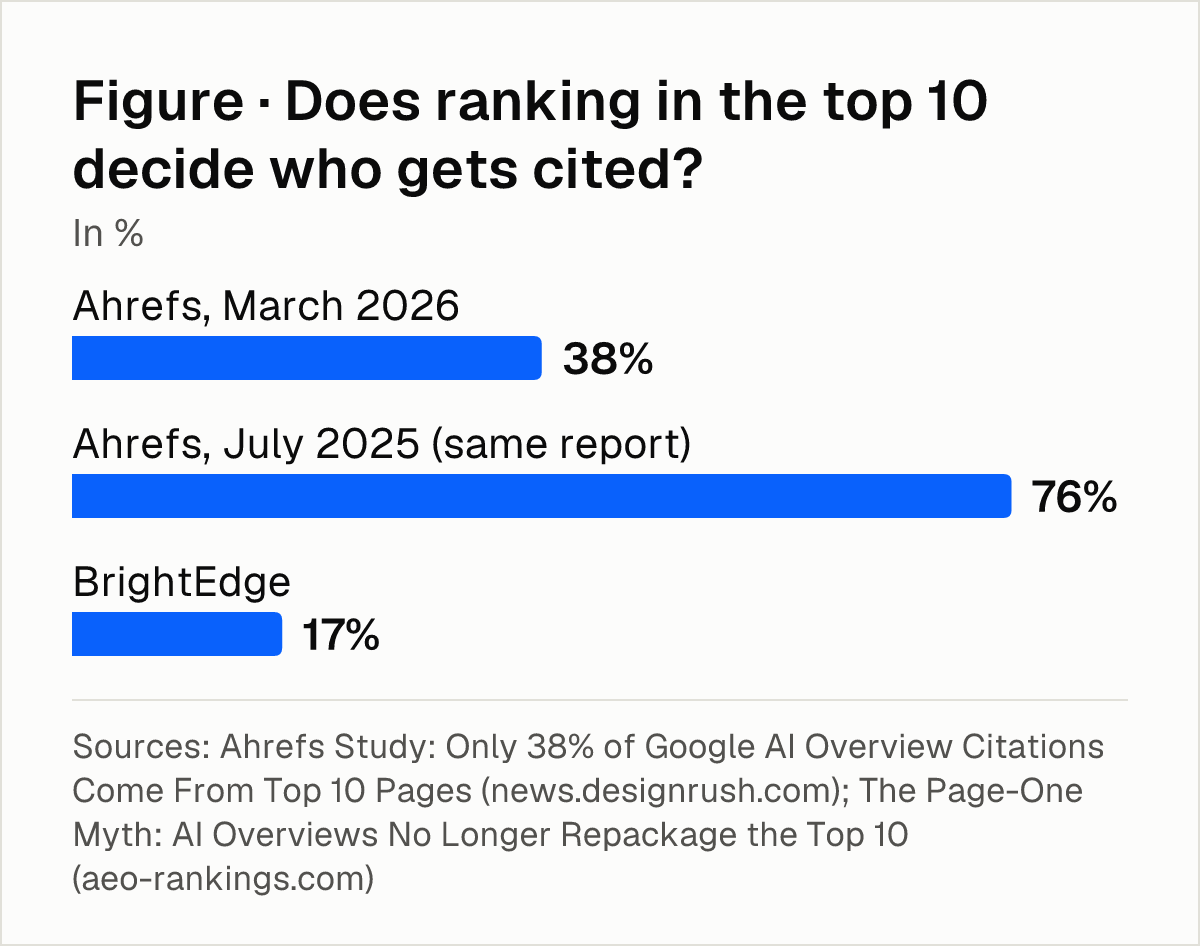
Don't read the drop from 76% to 38% as a trend. Ahrefs changed both its parser and its study sample, so the two figures are not a valid before-and-after line. What the disagreement does show is that a top-10 ranking alone is a weak predictor of citation. Test any vendor claim against your own dated records from step two.
Next steps
- Check indexing status and snippet directives (nosnippet, data-nosnippet, max-snippet, noindex) on your most important pages.
- Write down your target queries and note, with a date, whether each shows an AI Overview and which pages it links.
- Rewrite one page so each likely subtopic has a short, direct answer under its own heading.
- Remove any structured data property that describes text visitors can't see on the page.
- If you want the tracking done weekly, Citable measures whether ChatGPT, Gemini, Perplexity, Claude, Grok and Google AI cite or recommend a site. Its guide to appearing in Google AI Overviews covers what Google says and what it doesn't.
Frequently asked questions
How do I check whether my page is indexed and eligible for a snippet?
Open the URL in Search Console and confirm it is indexed. Then look for nosnippet, data-nosnippet, max-snippet or noindex directives, which Google lists as controls that limit what it shows from a page.
Do I need an llms.txt file for Google AI Overviews?
No. Google's AI features guide says you don't need to create new machine-readable files, AI text files or markup to appear in these features.
Does FAQ schema still help with AI Overviews?
Google says there is no special schema.org structured data you need to add for AI features. An Ahrefs study of 1,885 pages that added JSON-LD found no positive effect on citations, according to seo-kreativ. Keep any markup matched to the visible text.
Does ranking in the top 10 guarantee an AI Overview citation?
No. Ahrefs found that only 38% of cited pages also rank in the top 10 for the same query, while BrightEdge's own tracking puts the overlap at roughly 17%. Google also says AI Overviews often don't trigger at all.
How long does it take for a page change to show up in AI Overviews?
Google says crawling can take anywhere from several days to several months. Recheck the same queries on a fixed schedule and log the dates.
Sources
- AI Features and Your Website | Google Search Central
- Google Search Central's AI Overviews Guidance: How to Get Cited
- Is structured data your advantage for AI overviews?
- Google AI Overviews: The Ultimate Guide to Ranking in 2025
- Ahrefs Study: Only 38% of Google AI Overview Citations Come From Top 10 Pages
- The Page-One Myth: AI Overviews No Longer Repackage the Top 10
- Only 38% of AI Overview Citations Rank in Google's Top 10: What Changed?
Keep reading
6 November 2026 · 9 min read
Step by step: how to monitor competitors in AI search
Build a fixed set of buyer prompts, run them on the AI engines your buyers use, and track share of voice and cited sources over time to monitor competitors.
5 November 2026 · 7 min read
FAQ pages that AI assistants quote: what the evidence shows
Write each FAQ heading as the question a buyer types and answer it in one or two standalone sentences. Schema alone showed no citation lift in tests.
4 November 2026 · 7 min read
Does Schema Markup Help in AI Search? What the Google and Ahrefs Data Show
Schema markup is not a proven lever for AI citations: Google says it isn't required and an Ahrefs test found no major uplift. Here is what to do.