How AI Assistants Pick Sources: What's Documented and What Isn't
Citable · 18 October 2026 · 8 min read
No AI assistant publishes its full criteria for choosing sources. Google's AI optimization guide says its AI answers start from its core Search ranking systems, while OpenAI and Anthropic describe retrieval and citation only at a high level. Most of the "ranking factors" you will find online are third-party inference, so test them on your own queries before you act on them.
- Google's AI features retrieve pages through its core Search ranking systems, so normal Search eligibility comes first.
- A site must be included in Search generative AI features in Search Console to be eligible for display there, according to Google's guide.
- Perplexity read about ten relevant pages per query and credited only three or four, according to an arXiv study cited by AuthorityTech.
- Only 37.9% of Google AI Overview citations rank in the top 10 for the query, per Ahrefs data from March 2026.
Why doesn't any assistant publish its full criteria?
OpenAI's ChatGPT search help article explains that ChatGPT may search the web when a prompt could benefit from current information, then answers with links to sources. eSEOspace's review notes that the documentation says little about how sources are chosen beyond a single sentence.

Anthropic is more specific about format. Its search results documentation says Claude cites whole content blocks rather than arbitrary substrings, which shapes how a passage has to be structured to be quoted. Its web search support page says every response that uses live results includes citations, and it does not describe how sources are ranked.
Perplexity has not published how it scores sources. Any claim about its exact weighting is inference, even when the writer sounds certain. Read third-party guides as hypotheses to test.
How does each assistant retrieve sources?
Retrieval differs by product, and so does the documentation. The table separates what each vendor documents from what third parties claim.
| Assistant | What the vendor documents | What third parties claim |
|---|---|---|
| Google AI features | Retrieval from the Search index through core ranking systems (Google's guide) | Citations overlap only partly with top-10 rankings (Ahrefs, March 2026) |
| ChatGPT | Searches when a prompt may benefit from current information and links the sources it used (OpenAI Help Center) | Leans on directories, reviews and aggregators (Yoast); OpenAI does not confirm this |
| Claude | Citations on every response that uses live results (Anthropic support) | Live results come from Brave Search (Choco Media Agency) |
| Perplexity | Scoring method not published (eSEOspace) | Sources chosen for fit to a specific claim (Fokal) |
Google AI features
Google's AI features issue several related queries for one question, which it calls query fan-out. A page can therefore be pulled in for a sub-topic the user never typed.
Google also says a site must be included in Search generative AI features in Search Console to be eligible for display there. That is a condition beyond normal indexing. Google has started testing a Search Console control that lets site owners decide whether their pages appear in and help ground AI Overviews and AI Mode responses. For background on that surface, see the explainer on Google AI Mode.
ChatGPT
ChatGPT does not search for every prompt. When it does, OpenAI says it turns the request into one or more queries, retrieves results and writes an answer with links to the sources it used.
What it weighs among those results is unpublished. Yoast says ChatGPT leans more on third-party sources than on brand-owned content. OpenAI's documentation does not confirm that.
Claude
Choco Media Agency reports that Claude's live search results come from Brave Search, with about 86.7% overlap between cited URLs and Brave's top organic results. If that holds, Google rankings may not predict Claude citations. It is still an outside analysis, and Anthropic does not describe its ranking.
Perplexity
Fokal says Perplexity selects sources for how well they support a specific claim, so a narrow, verifiable claim on a mid-tier domain can beat a vague line on a major publication. Perplexity has not confirmed this.
Is a page that gets retrieved also cited?
Not always. The arXiv study cited by AuthorityTech found that Perplexity's Sonar read about ten relevant pages per query and cited only three or four. Retrieval visibility and a credited citation are different outcomes.
Ranking and citation also overlap only partly. According to Ahrefs data from March 2026, as cited by ContextBolt, only 37.9% of Google AI Overview citations rank in the top 10 for the query.
Google says what it values in the content itself. A summary that only restates information available elsewhere is less useful to its AI systems than a page with a first-hand, distinct point of view, according to Google's guide.
Which popular claims conflict with Google's documentation?
Several claims circulate as if they were official. Google's guide contradicts or does not support three of them:
- llms.txt: Google says llms.txt files are ignored by Google Search. Some third-party guides present the file as a citation lever. The llms.txt explainer covers what it does and does not do.
- Brand mentions: the same guide warns that seeking inauthentic "mentions" across the web isn't as helpful as it might seem for its AI features.
- Writing in chunks: Google says no special writing style or chunking is required for AI search.
"There's no requirement to break your content into tiny pieces for AI to better understand it." — Google, AI optimization guide
Splitting pages into tiny passages is therefore advice, not an official requirement. Clear, specific writing still helps your readers.
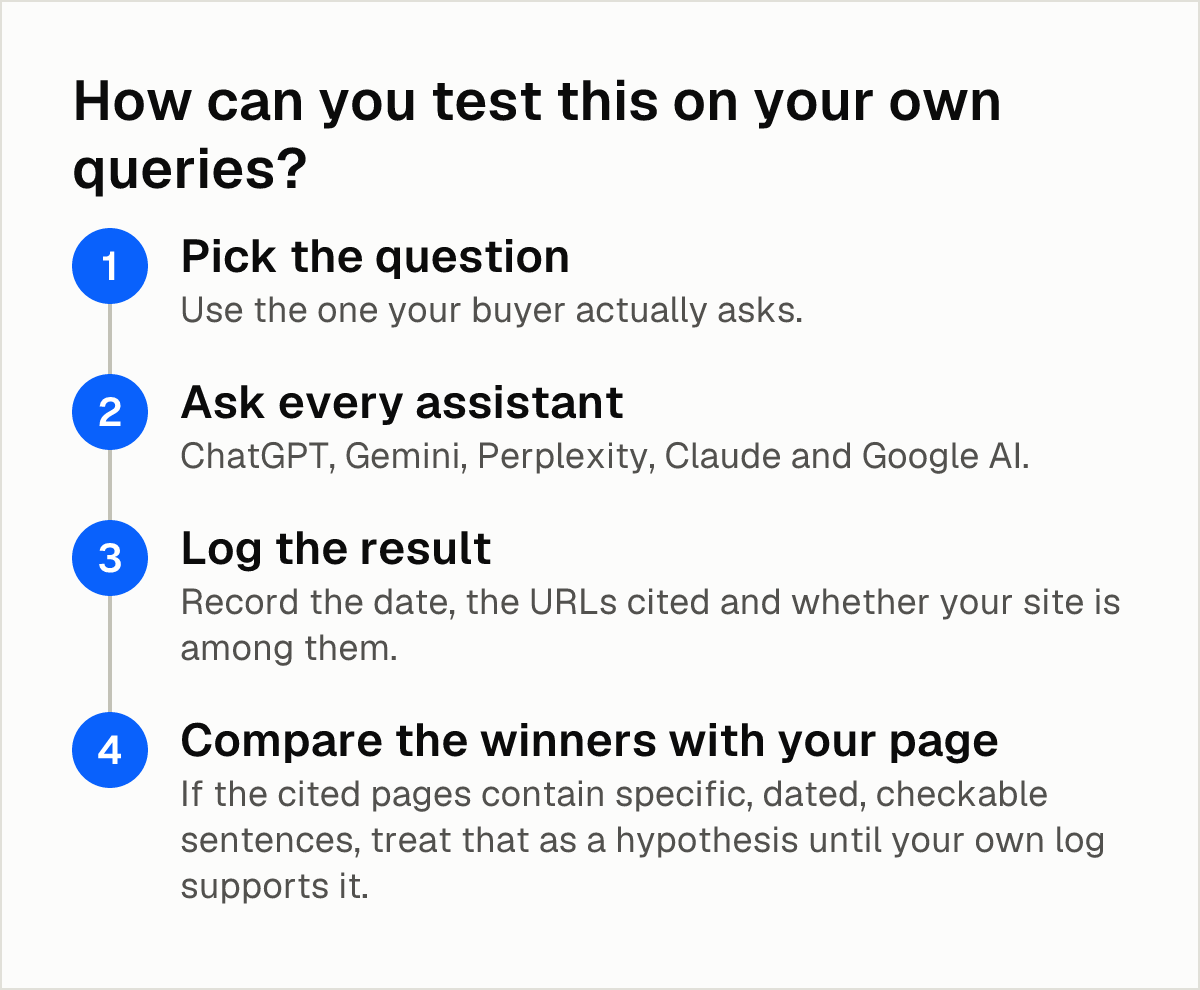
How can you test this on your own queries?
You don't need a tool to start. Run a small experiment:
- Pick the question: use the one your buyer actually asks.
- Ask every assistant: ChatGPT, Gemini, Perplexity, Claude and Google AI.
- Log the result: record the date, the URLs cited and whether your site is among them.
- Compare the winners with your page: if the cited pages contain specific, dated, checkable sentences, treat that as a hypothesis until your own log supports it.
Repeat the check over time, because one screenshot tells you little. Before you start, confirm your crawler rules allow the bots you want. The AI crawler checker shows whether robots.txt blocks ChatGPT, Perplexity or Claude, and the guide to robots.txt and AI crawlers explains what each rule controls.
Next steps
- Confirm your key pages are indexed normally and included in Search generative AI features in Search Console, as Google's guide describes.
- Write down five questions your buyers ask and run them through each assistant this week, logging the cited URLs with the date.
- Rewrite vague lines on your key pages as specific, dated, sourced claims, and add a first-hand point of view that a summary can't offer.
- Check your robots.txt rules for AI crawlers before you judge any result.
- If you want to track this every week across ChatGPT, Gemini, Perplexity, Claude, Grok and Google AI, Citable measures whether each one cites or recommends your site and works out why competitors are picked instead. Its robots.txt generator for AI search engines is a free starting point for crawler rules.
Frequently asked questions
Do ChatGPT, Perplexity and Claude cite the same websites for the same question?
Not necessarily. Google says its AI features retrieve pages from its own Search index, and Choco Media Agency reports that Claude's live results come from Brave Search. Each assistant has its own retrieval path, so test your question on each one.
Does ranking in Google improve my chances of being cited by ChatGPT or Claude?
For Google's own AI features, ranking matters because Google says they rely on its core Search ranking systems. For Claude, one third-party analysis points to Brave Search as the source of results. OpenAI does not publish how ChatGPT ranks sources.
Does llms.txt affect whether AI assistants cite my site?
Google says Google Search itself doesn't use llms.txt files. Third-party guides that present it as a citation lever are not backed by Google's documentation. Test it on your own queries before you rely on it.
Does being retrieved mean being cited?
No. An arXiv study cited by AuthorityTech found Perplexity's Sonar read about ten relevant pages per query and cited only three or four. Being read is a different outcome from being credited.
Do I need to split my pages into small chunks for AI search?
Google says there is no requirement to break content into tiny pieces for AI to understand it. No special writing style is required either, according to its AI optimization guide.
Sources
- Google's Guide to Optimizing for Generative AI Features on Google Search
- New opportunities, control and insights for website owners
- ChatGPT search for Enterprise and Edu | OpenAI Help Center
- ChatGPT Search Explained: How It Finds and Links to Websites - eSEOspace
- Search results - Claude Platform Docs
- Enable and use web search
- How Perplexity Chooses the Sources It Quotes - eSEOspace
- How Does Perplexity Choose Sources? The Retrieval Pipeline Explained
- AI Citations Explained: How they work and how cited by AI models • Yoast
- Does Claude Cite Your Website? What We Know About Getting Found in Anthropic's AI Search in 2026
- How Perplexity Decides Which Sources to Cite
- How AI Assistants Choose Citations (2026)
Keep reading
6 November 2026 · 9 min read
Step by step: how to monitor competitors in AI search
Build a fixed set of buyer prompts, run them on the AI engines your buyers use, and track share of voice and cited sources over time to monitor competitors.
5 November 2026 · 7 min read
FAQ pages that AI assistants quote: what the evidence shows
Write each FAQ heading as the question a buyer types and answer it in one or two standalone sentences. Schema alone showed no citation lift in tests.
4 November 2026 · 7 min read
Does Schema Markup Help in AI Search? What the Google and Ahrefs Data Show
Schema markup is not a proven lever for AI citations: Google says it isn't required and an Ahrefs test found no major uplift. Here is what to do.