AI search checklist for small businesses: what to do first
Citable · 10 November 2026 · 7 min read
Start with what Google documents as required: the page must be indexed, eligible to show with a snippet, and included in Search generative AI features in Search Console. Then make your business facts consistent and measure a fixed set of buyer prompts before and after each change. No checklist can guarantee a citation.
The essentials
- Check indexing, snippet eligibility and Search Console inclusion first. Google treats generative AI visibility as part of regular search.
- Record a Search Console baseline, then measure 30 to 50 tagged core prompts, each run three to five times within 24 to 72 hours, as Aleyda Solis suggests.
- Keep your name, address, phone and services identical on your website and your Google Business Profile.
- Change one thing at a time, and judge the result by enquiries, not by mention counts alone.
What does Google require before anything else?
Optimizing for generative AI search is still SEO, because Google treats it as part of the search experience. Your first checklist items are the ones you already know.
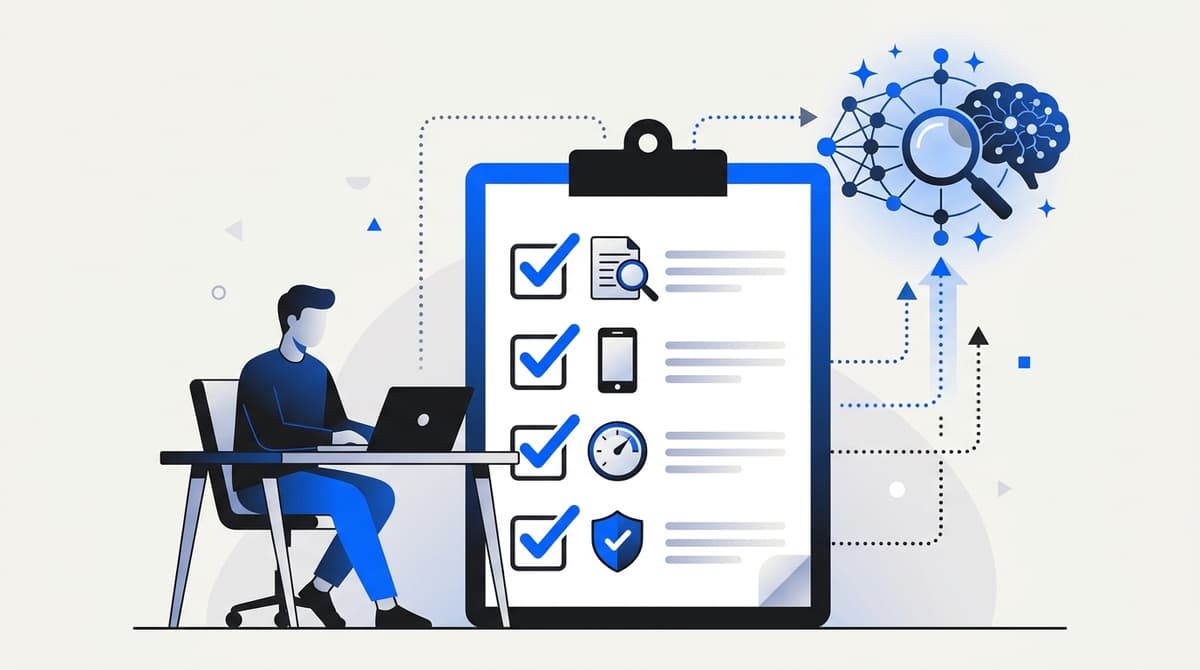
Eligibility depends on two conditions. The page must be indexed, and it must be eligible to appear in Google Search with a snippet. Check both before you change any content.
Then confirm that the site is included in Search generative AI features in Search Console. Do this before any editing.
"Indexing and serving aren't guaranteed." — Google, in its AI optimization guide
Use the list to remove blockers. A page can meet every requirement and still not be shown.
How do you see what changed in Google?
Google recommends the Generative AI performance report in Search Console to see how your content performs in its generative AI features on Search and Discover. The same guide names it as the measurement tool.
Record the report before you change pages. That gives you a Google baseline. It covers Google only, so it will not show what ChatGPT, Perplexity or other assistants say about you.
Google also states that no third-party tool has access to its internal ranking or AI systems. Treat any vendor claim about Google internals with skepticism.
Which checklist claims can you skip?
Several claims in small-business checklists conflict with Google's own guidance. The table sets them side by side.
| Claim | What Google says | What to do |
|---|---|---|
| You need llms.txt to appear in Google | Not required for Google Search; other AI services may use it | Decide on its own merits |
| Content must be split into small chunks for AI | No such requirement, and no ideal page length exists | Write for the reader |
| Structured data boosts AI visibility | Not required for generative AI search; still useful for rich-result eligibility | Use it for rich results |
| Inauthentic mentions help | Not as helpful as they might seem | Skip them |
On llms.txt, Google says you don't need new machine-readable files to appear in Google Search. Other AI services may read them, so the choice depends on which services matter to you. For what the file does and whether it helps, read llms.txt explained.
On structured data, a Seresa checklist claims pages with it get 3.1x more AI Overview citations, citing a secondary source. That conflicts with Google's statement that it isn't required, so don't build your plan on it. Keep the markup if it helps rich results. For more detail, see structured data for AI search.
On JavaScript, LLMrefs says AI bots cannot see content loaded by JavaScript after render. If your key text loads late, compare the page source with the rendered page and check that the text appears in both. You can also test whether robots.txt blocks AI crawlers with the AI crawler checker.
On mentions, Google warns that seeking inauthentic "mentions" across the web is not as helpful as it might seem. Aleyda Solis's checklist goes further: fabricated reviews, manufactured community signals and citation gaming may bring short-term gains but will eventually be addressed.
How do you keep your business facts consistent?
Google says Merchant Center and Google Business Profile can help your products and services be visible in AI responses as well as in regular results.
Oui Digital's small-business guide advises measuring completed enquiries rather than counting AI mentions alone.
Do it in three steps:
- Master sheet: write your business name, address, phone number, email and list of services.
- Update what you control: your website, your Google Business Profile and any directory listing you manage, all from that sheet.
- Recheck on every change: each time you edit a service page or move offices.
How do you measure before you act?
Start with 30 to 50 tagged core prompts: the questions your buyers would ask an AI tool. Keep experimental prompts in a separate list so they don't distort your baseline. Aleyda Solis's checklist recommends this starting point.
Solis also suggests running each core prompt three to five times within a fixed 24 to 72 hour window. Log the platform, location and account state every time, so you compare like with like.
Record the baseline before you change anything. Without it, you can't tell whether a later change made a difference. To see how much traffic assistants send you, tracking ChatGPT traffic in GA4 covers the setup.
Judge the work by enquiries. Oui Digital recommends measuring completed enquiries rather than counting AI mentions alone. At each check, ask whether a buyer contacted you, and whether an AI tool named you.
How do you run this as a loop?
Measure, change one thing, retest under the same conditions, then keep, revise or stop the change. If you change several things at once, you can't tell which caused the result.
No checklist guarantees a citation. Google states that indexing and serving aren't guaranteed, even when a page meets every requirement. Plan your time and budget on that basis.
Next steps
- Open Search Console and confirm your key pages are indexed, snippet-eligible and included in Search generative AI features.
- Save the current Generative AI performance report as your Google baseline.
- Write your master sheet of business facts and align your website and Google Business Profile with it.
- Draft 30 to 50 buyer prompts, tag them, and run each three to five times in one 24 to 72 hour window.
- If you would rather not run the loop by hand, Citable measures whether ChatGPT, Gemini, Perplexity, Claude, Grok and Google AI cite or recommend a site, and helps with page fixes. See how Citable works.
Frequently asked questions
How do I check whether ChatGPT or Perplexity recommends my small business?
Run a fixed set of buyer prompts in each tool, three to five times each within a 24 to 72 hour window, as Aleyda Solis recommends. Log the platform, location and account state, and note whether you are named.
Do I need llms.txt for my small business website?
Google says you don't need llms.txt or similar AI-specific files to appear in Google Search, according to its AI optimization guide. Other AI services may use them, so decide based on the services you care about.
Does structured data actually increase AI citations?
Google says structured data isn't required for generative AI search and that no special schema.org markup is needed. It remains useful for rich-result eligibility.
How do I set up Google Search Console for AI Overviews reporting?
Verify your site in Search Console, then use the Generative AI performance report, which Google recommends for measuring performance in its generative AI features. Confirm the site is included in Search generative AI features, and record the report as a baseline before making changes.
Sources
- Google's Guide to Optimizing for Generative AI Features on Google Search
- The AI Search Optimization Checklist, Aleyda Solis
- AI Search Optimization for Small Business Websites, Oui Digital
- The Small Business AI Search Optimization Checklist for 2026, Seresa
- Generative Engine Optimization (GEO): The 2026 Guide, LLMrefs
Keep reading
11 November 2026 · 14 min read
Google AI Mode vs AI Overviews: Differences and What to Check
AI Overviews summarize on the normal results page; AI Mode is a separate conversational search. See how they differ and what to check on your site.
9 November 2026 · 7 min read
Which Websites ChatGPT and Perplexity Cite, by Industry
No single list exists: Reddit leads many rankings, but ChatGPT and Perplexity favour different sites and the leaders change by sector. See the data.
8 November 2026 · 9 min read
Does Your Brand Name Affect AI Recommendations?
Sometimes. One preprint shows a known name winning when specs match, but entity clarity, web mentions and prompt wording usually matter more.